▱ Parallelogram Area Calculator

Calculate the area of a parallelogram from its base and perpendicular height.

No ratings yet — be the first

Enter details

Parallelogram area
A =×
  • Base
  • Height

Log in or create a free account to save your inputs and results, so you don't have to enter them again next time.🔒 No spam, ever. We never sell or share your details, and you can delete your history or account at any time. Privacy policy

Fill in the details and click Calculate to see your results.

Formula at a glance

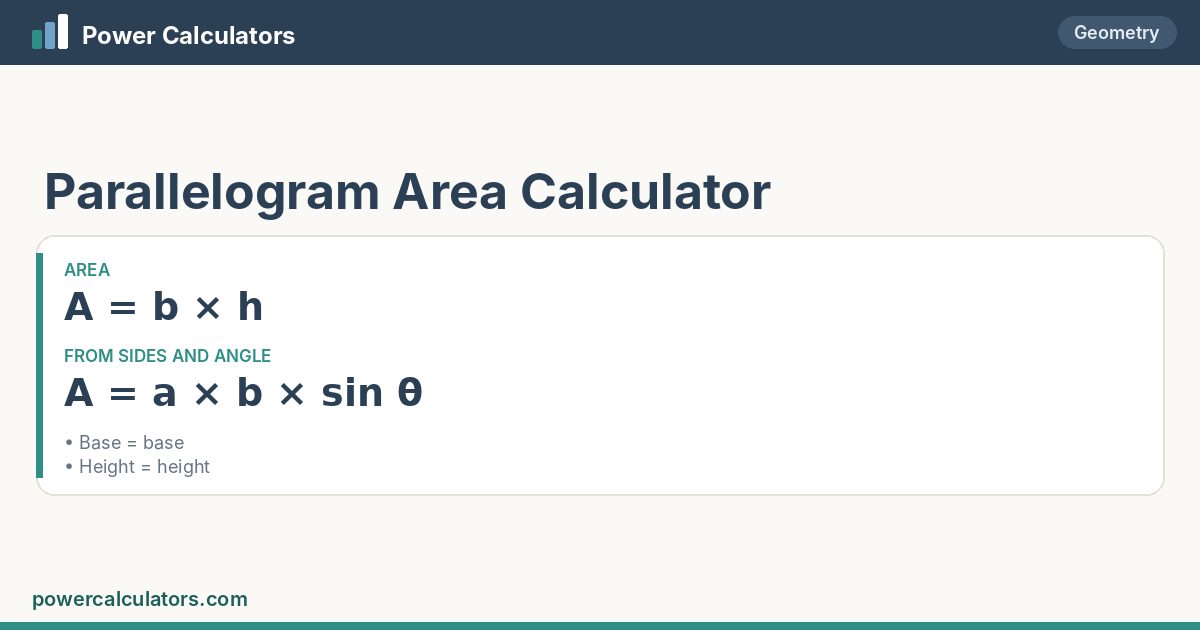
Parallelogram Area formula: A = b × h; A = a × b × sin θ
How the parallelogram area works: A = b × h

Rate this calculator

Was it useful? A quick star rating helps others — and you can leave a comment too.
Rate it: ★ ★ ★ ★ ★

📘 About the Parallelogram Area Calculator

The area of a parallelogram is its base multiplied by its perpendicular height — the straight-line distance between the two parallel sides, not the slanted side.

If you know two sides a, b and the angle θ between them, area = a × b × sin θ.

Use the same unit for every length; the area comes out in that unit squared (cm²) and volume in that unit cubed (cm³).

🧮 Formula

Area
A = b × h
From sides and angle
A = a × b × sin θ

Where

  • Base = base
  • Height = height
Enter the dimensions of the selected geometric shape.

✏️ Worked examples

Base 10, height 6

You enter
Base10
Height6
You get
Area60

Area 60.

Base 15 cm, height 8 cm

You enter
Base15
Height8
You get
Area120

Area 120 cm².

🧭 How to use this calculator

What you enter

  • Base
  • Height

What you get

  • Area

💡 Common uses

  • School geometry and homework
  • Construction and measurement
  • Area, perimeter, surface area and volume calculations

❓ Frequently asked questions

How do you find the area of a parallelogram?

Multiply the base by the perpendicular height. Base 10, height 6 → 60.

Is the slanted side the height?

No. The height must be at right angles to the base.