📈 401(k) Calculator: Retirement Balance & Employer Match

How much will your 401(k) be worth when you retire? Include your employer match.

No ratings yet — be the first

Enter details

e.g. 50% of what you put in…

Log in or create a free account to save your inputs and results, so you don't have to enter them again next time.🔒 No spam, ever. We never sell or share your details, and you can delete your history or account at any time. Privacy policy

Fill in the details and click Calculate to see your results.

Formula at a glance

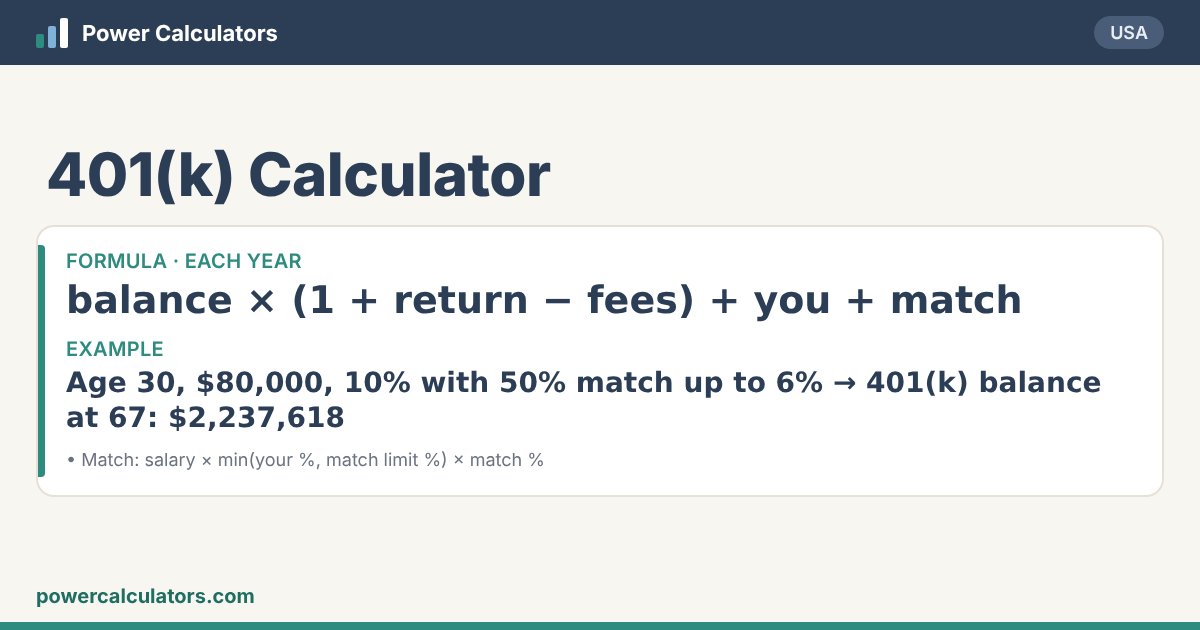
401(k) Calculator: Each year — balance × (1 + return − fees) + you + match. Example: Age 30, $80,000, 10% with 50% match up to 6% → 401(k) balance at 67: $2,237,618
How the 401(k) Calculator works: Each year — balance × (1 + return − fees) + you + match

📱 Also in our Android apps

This calculator is in each of these free apps. Sign in with the same account to keep your history in sync.

  • Financial CalculatorEMI, SIP, PPF, NPS, post office schemes and government-employee calculatorsGet it on Google Play
  • Govt Employee CalculatorSalary, DA, pension and income tax for government employeesGet it on Google Play

Rate this calculator

Was it useful? A quick star rating helps others — and you can leave a comment too.
Rate it: ★ ★ ★ ★ ★

📘 About the 401(k) Calculator

A 401(k) lets you save for retirement straight from your paycheck, usually before tax. For 2026 you can defer up to $24,500, plus $8,000 catch-up from age 50 or $11,250 at ages 60–63. Many employers add a match, such as 50% of what you put in up to 6% of salary — always contribute enough to get it all.

The calculator grows your balance each year with your contributions, the match, pay rises and investment returns after fees, and shows the income a 4% withdrawal rate could give.

🧮 Formula

Each year
balance × (1 + return − fees) + you + match
Match
salary × min(your %, match limit %) × match %

✏️ Worked examples

Age 30, $80,000, 10% with 50% match up to 6%

You enter
Current age30 years
Retirement age67 years
Salary80,000 $
You contribute10%
Employer matches50%
…up to this % of salary6%
Current 401(k) balance0 $
Yearly pay rise3%
Expected yearly return7%
Fund fees (expense ratio)0.5%
You get
401(k) balance at 67$2,237,618
You contribute in total$529,394
Employer match in total$158,818
Investment growth$1,549,406
Income at 4% a year from it$89,505 a year ($7,459 a month, before tax)
This year you put in$8,000 (limit $24,500)

$2,237,618.

Age 45, $120,000, $150,000 saved, 15%

You enter
Current age45 years
Retirement age65 years
Salary120,000 $
You contribute15%
Employer matches50%
…up to this % of salary6%
Current 401(k) balance150,000 $
Yearly pay rise3%
Expected yearly return7%
Fund fees (expense ratio)0.5%
You get
401(k) balance at 65$1,622,959
You contribute in total$483,667
Employer match in total$96,733
Investment growth$892,559
Income at 4% a year from it$64,918 a year ($5,410 a month, before tax)
This year you put in$18,000 (limit $24,500)

$1,622,959.

🧭 How to use this calculator

What you enter

  • Current age (years)
  • Retirement age (years)
  • Salary ($)
  • You contribute (%)
  • Employer matches (%)e.g. 50% of what you put in…
  • …up to this % of salary (%)
  • Current 401(k) balance ($)
  • Yearly pay rise (%)
  • Expected yearly return (%)
  • Fund fees (expense ratio) (%)

What you get

  • 401(k) balance at 67
  • You contribute in total
  • Employer match in total
  • Investment growth
  • Income at 4% a year from it
  • This year you put in

❓ Frequently asked questions

What is the 401(k) limit for 2026?

$24,500 for employees, plus $8,000 catch-up at 50+ (or $11,250 for ages 60–63). Total contributions including employer money are capped at $72,000.

How much should I put in my 401(k)?

At least enough to get the full employer match, then aim for 10–15% of pay in total if you can.

How much will I have in my 401(k) at 65?

Someone saving 10% of an $80,000 salary from 30 with a 50% match up to 6% could have around $2 million by 67 at a 7% return — in future dollars, before tax.

Should I choose a Roth 401(k)?

Roth contributions are taxed now and withdrawals later are tax-free; it suits people who expect a higher tax rate in retirement.