⚖️ Roth vs Traditional IRA / 401(k) Calculator

Pay tax now or later? Compare both accounts on the same out-of-pocket cost.

No ratings yet — be the first

Enter details

Log in or create a free account to save your inputs and results, so you don't have to enter them again next time.🔒 No spam, ever. We never sell or share your details, and you can delete your history or account at any time. Privacy policy

Fill in the details and click Calculate to see your results.

Formula at a glance

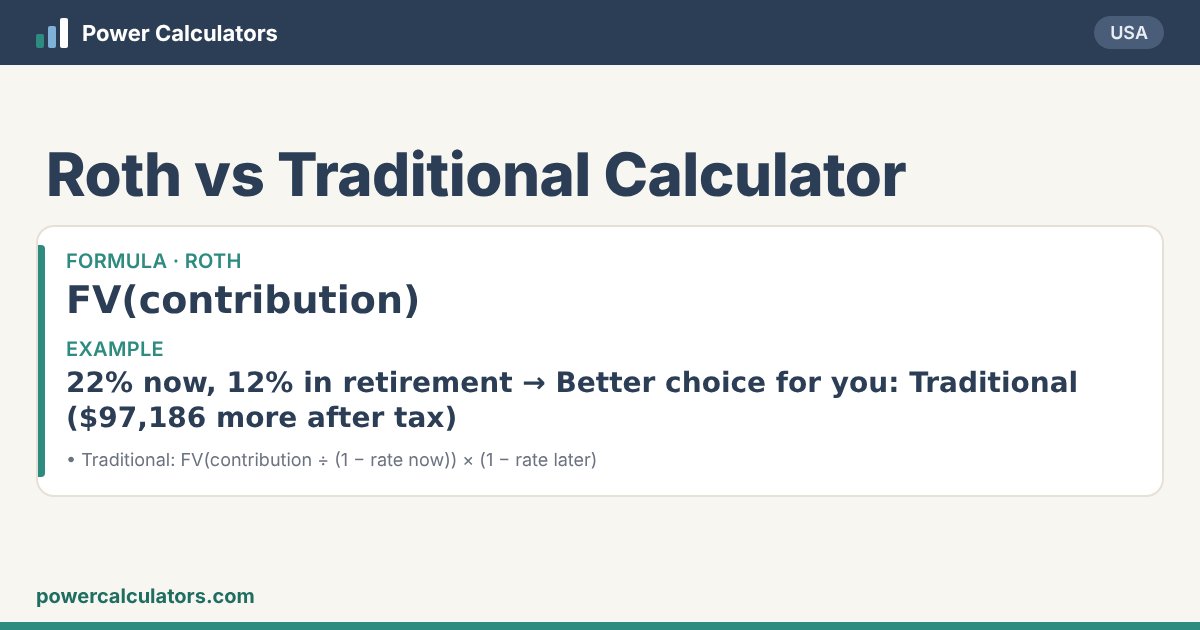
Roth vs Traditional Calculator: Roth — FV(contribution). Example: 22% now, 12% in retirement → Better choice for you: Traditional ($97,186 more after tax)
How the Roth vs Traditional Calculator works: Roth — FV(contribution)

📱 Also in our Android apps

This calculator is in each of these free apps. Sign in with the same account to keep your history in sync.

  • Financial CalculatorEMI, SIP, PPF, NPS, post office schemes and government-employee calculatorsGet it on Google Play
  • Govt Employee CalculatorSalary, DA, pension and income tax for government employeesGet it on Google Play

Rate this calculator

Was it useful? A quick star rating helps others — and you can leave a comment too.
Rate it: ★ ★ ★ ★ ★

📘 About the Roth vs Traditional IRA / 401

A traditional account gives a tax deduction today and you pay tax on withdrawals. A Roth gives no deduction but withdrawals are tax-free. If your tax rate is the same then as now, both end up equal; a lower rate in retirement favours traditional, a higher one favours Roth.

For a fair comparison the calculator assumes you invest the tax saving from a traditional contribution, so both cost you the same each year.

🧮 Formula

Roth
FV(contribution)
Traditional
FV(contribution ÷ (1 − rate now)) × (1 − rate later)

✏️ Worked examples

22% now, 12% in retirement

You enter
Yearly contribution (out of pocket)7,500 $
Years until retirement30 years
Expected yearly return7%
Your tax rate now (federal + state)22%
Expected tax rate in retirement12%
You get
Better choice for youTraditional ($97,186 more after tax)
Roth: after-tax value$758,048
Traditional: after-tax value$855,233 ($971,856 before tax)
Same out-of-pocket cost$7,500 a year (traditional invests the tax saving too: $9,615)

Traditional ($97,186 more after tax).

12% now, 22% later

You enter
Yearly contribution (out of pocket)7,500 $
Years until retirement30 years
Expected yearly return7%
Your tax rate now (federal + state)12%
Expected tax rate in retirement22%
You get
Better choice for youRoth ($86,142 more after tax)
Roth: after-tax value$758,048
Traditional: after-tax value$671,906 ($861,418 before tax)
Same out-of-pocket cost$7,500 a year (traditional invests the tax saving too: $8,523)

Roth ($86,142 more after tax).

🧭 How to use this calculator

What you enter

  • Yearly contribution (out of pocket) ($)
  • Years until retirement (years)
  • Expected yearly return (%)
  • Your tax rate now (federal + state) (%)
  • Expected tax rate in retirement (%)

What you get

  • Better choice for you
  • Roth: after-tax value
  • Traditional: after-tax value
  • Same out-of-pocket cost

❓ Frequently asked questions

Is Roth or traditional better?

Roth is better if you expect a higher tax rate in retirement; traditional is better if you expect a lower one. Many people split contributions to hedge.

Who should choose a Roth?

Younger workers in the 10–12% brackets, people expecting large pensions or RMDs, and anyone wanting tax-free money for heirs.

Who should choose traditional?

People in the 24% bracket or higher who expect lower income in retirement, and those who need the deduction to qualify for credits.

Do Roth accounts have RMDs?

Roth IRAs and (since 2024) Roth 401(k)s have no required minimum distributions for the original owner.