🌍 Household Carbon Footprint Calculator (India)

How much CO₂ does your home produce? Add up electricity, cooking, travel, food and shopping.

No ratings yet — be the first

Enter details

Log in or create a free account to save your inputs and results, so you don't have to enter them again next time.🔒 No spam, ever. We never sell or share your details, and you can delete your history or account at any time. Privacy policy

Fill in the details and click Calculate to see your results.

Formula at a glance

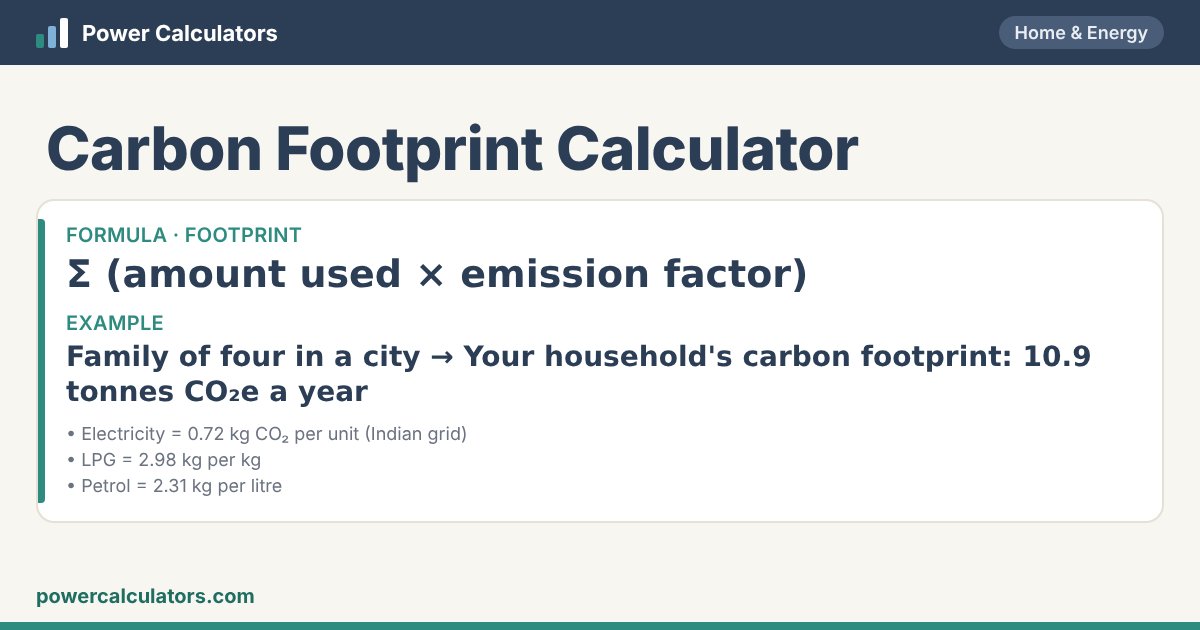
Carbon Footprint Calculator: Footprint — Σ (amount used × emission factor). Example: Family of four in a city → Your household's carbon footprint: 10.9 tonnes CO₂e a year
How the Carbon Footprint Calculator works: Footprint — Σ (amount used × emission factor)

Rate this calculator

Was it useful? A quick star rating helps others — and you can leave a comment too.
Rate it: ★ ★ ★ ★ ★

📘 About the Household Carbon Footprint Calculator

A carbon footprint is the greenhouse gas your activities release, measured in tonnes of CO₂-equivalent. For most Indian households the biggest parts are electricity (India's grid is mostly coal, about 0.72 kg of CO₂ per unit), vehicle fuel and food.

Enter your monthly bills and habits. The calculator uses standard emission factors to estimate your household's yearly footprint, divides it per person, compares it with averages for India (about 2 tonnes per person) and the world (about 4.7 tonnes), and shows which source is largest.

🧮 Formula

Footprint
Σ (amount used × emission factor)

Where

  • Electricity = 0.72 kg CO₂ per unit (Indian grid)
  • LPG = 2.98 kg per kg
  • Petrol = 2.31 kg per litre
  • Diesel = 2.68 kg per litre

✏️ Worked examples

Family of four in a city

You enter
People in the household4
Electricity250 units a month
LPG cylinders (14.2 kg)8 a year
Piped gas (PNG)0 SCM a month
Petrol40 litres a month
Diesel0 litres a month
CNG0 kg a month
Short return flights (under 3 h)2 a year
Long return flights (over 6 h)0 a year
Usual dietVegetarian
Shopping, clothes & gadgetsAverage
You get
Your household's carbon footprint10.9 tonnes CO₂e a year
Per person2.74 tonnes a year
Compared withIndia average about 2.0 t per person · world 4.7 t · USA 14 t · 1.5 °C target about 2.3 t by 2030
Trees needed to absorb it521 trees (about 21 kg CO₂ each a year)

10.9 tonnes CO₂e a year; 2.74 tonnes a year per person.

Couple with a car and long flights

You enter
People in the household2
Electricity400 units a month
LPG cylinders (14.2 kg)0 a year
Piped gas (PNG)12 SCM a month
Petrol80 litres a month
Diesel0 litres a month
CNG0 kg a month
Short return flights (under 3 h)4 a year
Long return flights (over 6 h)2 a year
Usual dietMeat most days
Shopping, clothes & gadgetsHigh
You get
Your household's carbon footprint17.2 tonnes CO₂e a year
Per person8.59 tonnes a year
Compared withIndia average about 2.0 t per person · world 4.7 t · USA 14 t · 1.5 °C target about 2.3 t by 2030
Trees needed to absorb it818 trees (about 21 kg CO₂ each a year)

8.59 tonnes a year per person.

🧭 How to use this calculator

What you enter

  • People in the household
  • Electricity (units a month)
  • LPG cylinders (14.2 kg) (a year)
  • Piped gas (PNG) (SCM a month)
  • Petrol (litres a month)
  • Diesel (litres a month)
  • CNG (kg a month)
  • Short return flights (under 3 h) (a year)
  • Long return flights (over 6 h) (a year)
  • Usual diet
  • Shopping, clothes & gadgets

What you get

  • Your household's carbon footprint
  • Per person
  • Compared with
  • Trees needed to absorb it

💡 Biggest cuts

  • Rooftop solar can cut the electricity part to near zero.
  • One long-haul return flight ≈ 2 tonnes — a whole year for an average Indian.
  • Car-pool or use the metro for daily trips.
  • Set the AC at 24–26 °C.

❓ Frequently asked questions

What is the average carbon footprint in India?

About 2 tonnes of CO₂ per person a year from fossil fuels (Global Carbon Project), less than half the world average of about 4.7 tonnes and a seventh of the US figure.

What is the biggest cause of a household's carbon footprint?

In India, usually electricity — especially air conditioners — followed by petrol or diesel for vehicles and flights.

How can I reduce my carbon footprint?

Rooftop solar, efficient appliances, an EV or public transport, fewer flights and more plant-based meals make the biggest difference.