🌧️ Rainwater Harvesting Calculator: Litres from Your Roof

Every millimetre of rain on a square metre of roof gives one litre of water. See how much your roof can save.

No ratings yet — be the first

Enter details

Log in or create a free account to save your inputs and results, so you don't have to enter them again next time.🔒 No spam, ever. We never sell or share your details, and you can delete your history or account at any time. Privacy policy

Fill in the details and click Calculate to see your results.

Formula at a glance

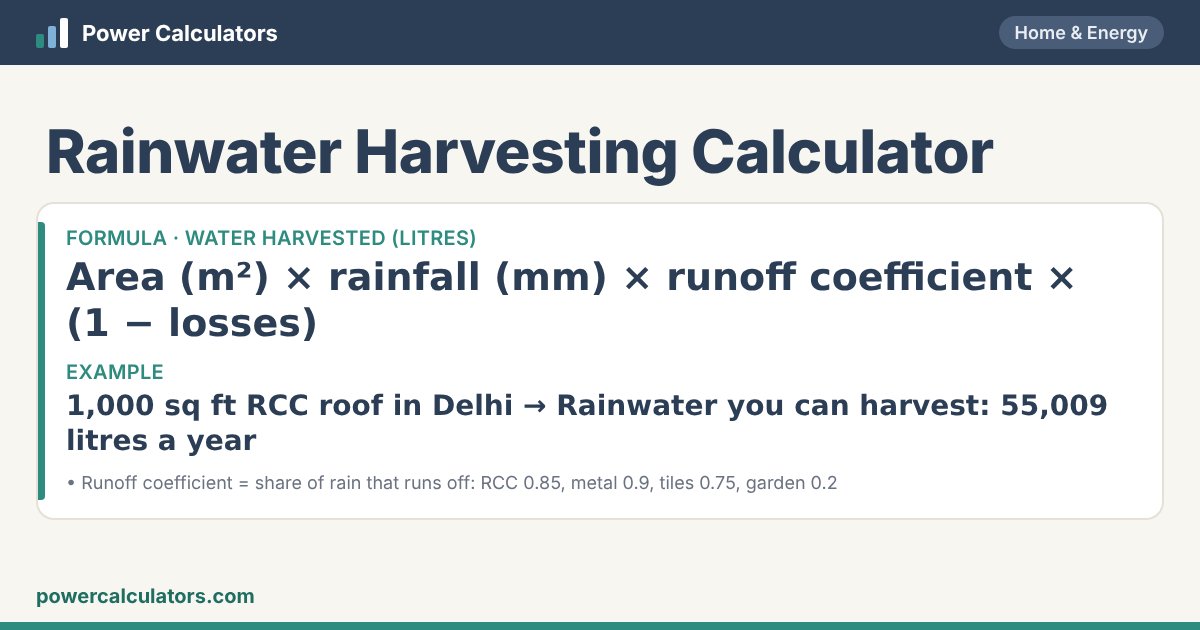
Rainwater Harvesting Calculator: Water harvested (litres) — Area (m²) × rainfall (mm) × runoff coefficient × (1 − losses). Example: 1,000 sq ft RCC roof in Delhi → Rainwater you can harvest: 55,009 litres a year
How the Rainwater Harvesting Calculator works: Water harvested (litres) — Area (m²) × rainfall (mm) × runoff coefficient × (1 − losses)

Rate this calculator

Was it useful? A quick star rating helps others — and you can leave a comment too.
Rate it: ★ ★ ★ ★ ★

📘 About the Rainwater Harvesting Calculator

Rainwater harvesting either stores roof water in a tank or sends it down a recharge pit or borewell to refill groundwater. In a city like Delhi with about 775 mm of rain a year, a 1,000 sq ft concrete roof collects around 55,000 litres — enough for weeks of a family's water.

Choose your city (or enter your own rainfall), the roof area and surface. The calculator applies the runoff coefficient and losses, and suggests a storage tank and recharge-pit size.

🧮 Formula

Water harvested (litres)
Area (m²) × rainfall (mm) × runoff coefficient × (1 − losses)

Where

  • Runoff coefficient = share of rain that runs off: RCC 0.85, metal 0.9, tiles 0.75, garden 0.2

✏️ Worked examples

1,000 sq ft RCC roof in Delhi

You enter
Roof / catchment area1000
Area insquare feet
City (average rainfall)Delhi / NCR (774 mm)
Roof surfaceConcrete (RCC) roof
Losses (first flush, filter, spills)10%
People in the home4
Water each person uses a day135 litres
You get
Rainwater you can harvest55,009 litres a year
That is55 cubic metres (5 water tankers of 12,000 L)
Rainfall used774 mm a year (Delhi / NCR)
In the wettest month (about 30% of the year)16,503 litres
Storage tank to aim for3,000 litres (or send the rest to a recharge pit)
Covers your household's use for102 days (4 people at 135 litres each a day)
Recharge pit size (approx.)13.8 m³ — for example 2.6 m × 2.6 m × 2 m deep

55,009 litres a year.

2,000 sq ft roof in Bengaluru

You enter
Roof / catchment area2000
Area insquare feet
City (average rainfall)Bengaluru (970 mm)
Roof surfaceConcrete (RCC) roof
Losses (first flush, filter, spills)10%
People in the home5
Water each person uses a day135 litres
You get
Rainwater you can harvest137,878 litres a year
That is137.9 cubic metres (11 water tankers of 12,000 L)
Rainfall used970 mm a year (Bengaluru)
In the wettest month (about 30% of the year)41,363 litres
Storage tank to aim for7,000 litres (or send the rest to a recharge pit)
Covers your household's use for204 days (5 people at 135 litres each a day)
Recharge pit size (approx.)34.5 m³ — for example 4.2 m × 4.2 m × 2 m deep

137,878 litres a year.

🧭 How to use this calculator

What you enter

  • Roof / catchment area
  • Area in
  • City (average rainfall)
  • Or your yearly rainfall (optional) (mm)
  • Roof surface
  • Losses (first flush, filter, spills) (%)
  • People in the home
  • Water each person uses a day (litres)

What you get

  • Rainwater you can harvest
  • That is
  • Rainfall used
  • In the wettest month (about 30% of the year)
  • Storage tank to aim for
  • Covers your household's use for
  • Recharge pit size (approx.)

💡 Simple system

  • Gutters and downpipes from the roof.
  • A first-flush diverter to waste the first dirty rain.
  • A filter (sand, gravel, charcoal or mesh).
  • A tank, a recharge pit or an old borewell for the overflow.

❓ Frequently asked questions

How much rainwater can I collect from 1,000 sq ft?

About 93 m² × rainfall. In Mumbai (2,200 mm) roughly 1.5 lakh litres a year; in Delhi about 55,000 litres; in Jaipur about 43,000.

Is rainwater harvesting compulsory?

Many cities require it for plots above a set size, including Delhi (100 m² and above), Bengaluru, Chennai and Hyderabad. Rules and rebates vary by city.

Is harvested rainwater safe to drink?

Roof rainwater needs filtering and disinfection before drinking. It is ideal for gardening, washing, flushing and recharging groundwater.