× Cross Product Calculator (and Dot Product)

a × b with every component worked out — and everything else about the two vectors.

No ratings yet — be the first

Enter details

Log in or create a free account to save your inputs and results, so you don't have to enter them again next time.🔒 No spam, ever. We never sell or share your details, and you can delete your history or account at any time. Privacy policy

Fill in the details and click Calculate to see your results.

Formula at a glance

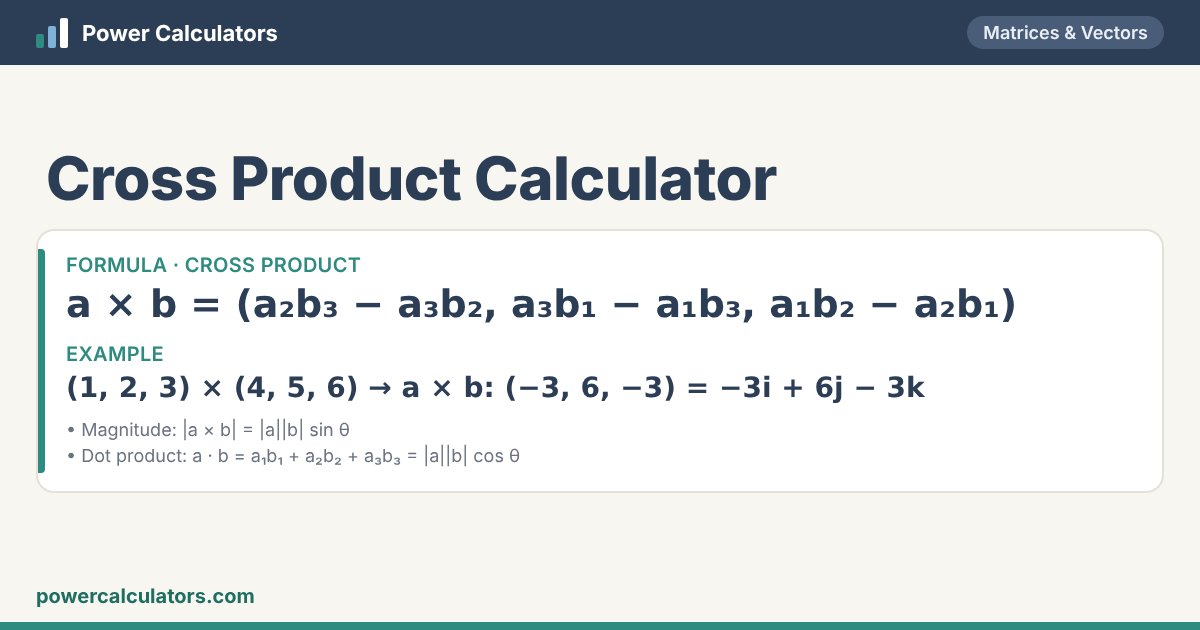
Cross Product Calculator: Cross product — a × b = (a₂b₃ − a₃b₂, a₃b₁ − a₁b₃, a₁b₂ − a₂b₁). Example: (1, 2, 3) × (4, 5, 6) → a × b: (−3, 6, −3)  =  −3i + 6j − 3k
How the Cross Product Calculator works: Cross product — a × b = (a₂b₃ − a₃b₂, a₃b₁ − a₁b₃, a₁b₂ − a₂b₁)

Rate this calculator

Was it useful? A quick star rating helps others — and you can leave a comment too.
Rate it: ★ ★ ★ ★ ★

📘 About the Cross Product Calculator

The cross product of two 3D vectors is a new vector perpendicular to both, with length equal to the area of the parallelogram they span. It gives normals to planes, torque (τ = r × F), angular momentum and the magnetic force on a moving charge. The dot product, by contrast, is a number that measures how much two vectors point the same way.

Enter two vectors. The calculator works out each component of a × b, the dot product, both magnitudes, the angle between them, the unit normal and the areas of the parallelogram and triangle — and with a third vector, the scalar triple product (the volume of the parallelepiped).

🧮 Formula

Cross product
a × b = (a₂b₃ − a₃b₂, a₃b₁ − a₁b₃, a₁b₂ − a₂b₁)
Magnitude
|a × b| = |a||b| sin θ
Dot product
a · b = a₁b₁ + a₂b₂ + a₃b₃ = |a||b| cos θ

✏️ Worked examples

(1, 2, 3) × (4, 5, 6)

You enter
Vector a1, 2, 3
Vector b4, 5, 6
You get
a × b(−3, 6, −3) = −3i + 6j − 3k
a · b (dot product)32
|a × b| (area of the parallelogram)3√6 ≈ 7.3484692
Area of the triangle3√6/2 ≈ 3.6742346
|a|, |b|3.7416574, 8.7749644
Angle between a and b12.9332°
Unit normal (a × b)/|a × b|(−0.408248, 0.816497, −0.408248)

(−3, 6, −3) = −3i + 6j − 3k.

i × j = k

You enter
Vector a1, 0, 0
Vector b0, 1, 0
Vector c (optional, for the triple product)0, 0, 1
You get
a × b(0, 0, 1) = 0i + 0j + 1k
a · b (dot product)0
|a × b| (area of the parallelogram)1
Area of the triangle1/2 ≈ 0.5
|a|, |b|1, 1
Angle between a and b90°
Unit normal (a × b)/|a × b|(0, 0, 1)
Scalar triple product c · (a × b)1 (volume of the parallelepiped = 1)

(0, 0, 1) = 0i + 0j + 1k.

🧭 How to use this calculator

What you enter

  • Vector a
  • Vector b
  • Vector c (optional, for the triple product)

What you get

  • a × b
  • a · b (dot product)
  • |a × b| (area of the parallelogram)
  • Area of the triangle
  • |a|, |b|
  • Angle between a and b
  • Unit normal (a × b)/|a × b|

❓ Frequently asked questions

Which way does the cross product point?

By the right-hand rule: point your fingers along a, curl them towards b, and your thumb gives a × b.

What if the cross product is zero?

The vectors are parallel (or one is zero).

Is a × b the same as b × a?

No — b × a = −(a × b). The cross product is anti-commutative.