∛ Cubic Equation Solver: Roots of ax³ + bx² + cx + d = 0

Enter the four coefficients.

No ratings yet — be the first

Enter details

Log in or create a free account to save your inputs and results, so you don't have to enter them again next time.🔒 No spam, ever. We never sell or share your details, and you can delete your history or account at any time. Privacy policy

Fill in the details and click Calculate to see your results.

Formula at a glance

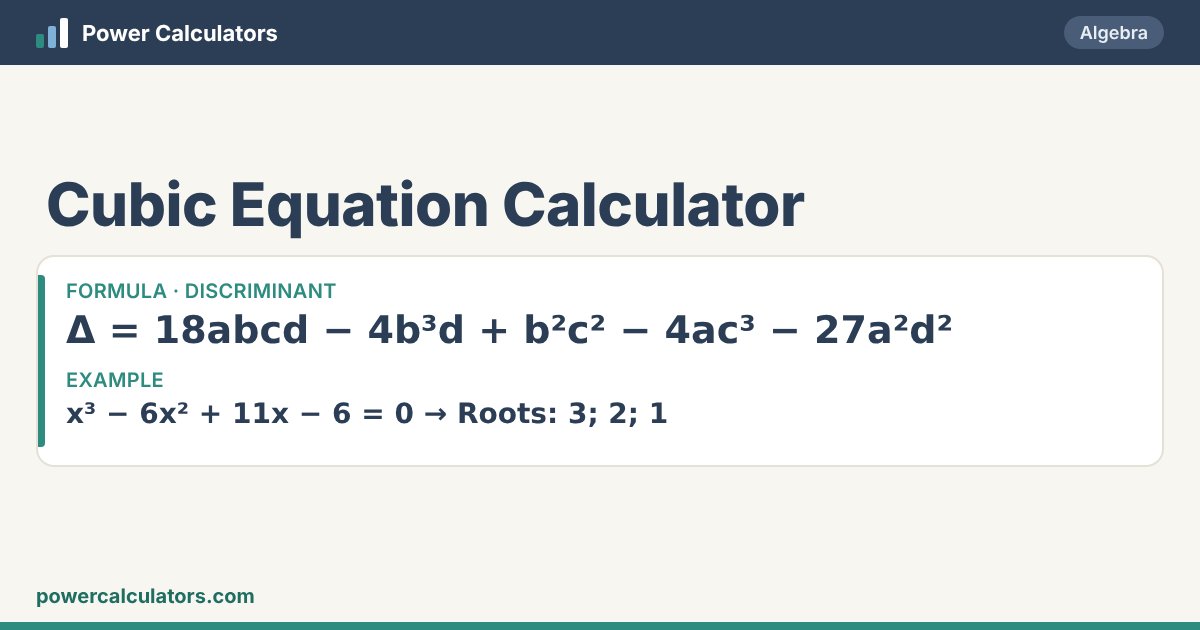
Cubic Equation Calculator: Discriminant — Δ = 18abcd − 4b³d + b²c² − 4ac³ − 27a²d². Example: x³ − 6x² + 11x − 6 = 0 → Roots: 3;  2;  1
How the Cubic Equation Calculator works: Discriminant — Δ = 18abcd − 4b³d + b²c² − 4ac³ − 27a²d²

Rate this calculator

Was it useful? A quick star rating helps others — and you can leave a comment too.
Rate it: ★ ★ ★ ★ ★

📘 About the Cubic Equation Calculator

Every cubic equation has three roots counting repeats. The discriminant tells you their type: positive means three different real roots, zero means a repeated root, and negative means one real root and a pair of complex roots.

The calculator uses the trigonometric method when all three roots are real and Cardano's formula otherwise. The roots always satisfy x₁ + x₂ + x₃ = −b/a and x₁x₂x₃ = −d/a, which is a quick way to check them.

🧮 Formula

Discriminant
Δ = 18abcd − 4b³d + b²c² − 4ac³ − 27a²d²

✏️ Worked examples

x³ − 6x² + 11x − 6 = 0

You enter
a (x³)1
b (x²)-6
c (x)11
d (constant)-6
You get
Roots3; 2; 1
Equation1x³ − 6x² + 11x − 6 = 0
Real roots3
Discriminant Δ4
Sum / product of roots6 / 6

The roots are 3; 2; 1.

x³ + x + 1 = 0

You enter
a (x³)1
b (x²)0
c (x)1
d (constant)1
You get
Roots-0.682328; 0.341164 + 1.161541i; 0.341164 − 1.161541i
Equation1x³ + 0x² + 1x + 1 = 0
Real roots1
Discriminant Δ-31
Sum / product of roots0 / -1

The roots are -0.682328; 0.341164 + 1.161541i; 0.341164 − 1.161541i.

🧭 How to use this calculator

What you enter

  • a (x³)
  • b (x²)
  • c (x)
  • d (constant)

What you get

  • Roots
  • Equation
  • Real roots
  • Discriminant Δ
  • Sum / product of roots

❓ Frequently asked questions

How many roots does a cubic have?

Three, counting repeated and complex roots; at least one is always real.