÷ Synthetic Division & Polynomial Long Division Calculator

Find the quotient and remainder — with the synthetic division table filled in.

No ratings yet — be the first

Enter details

Log in or create a free account to save your inputs and results, so you don't have to enter them again next time.🔒 No spam, ever. We never sell or share your details, and you can delete your history or account at any time. Privacy policy

Fill in the details and click Calculate to see your results.

Formula at a glance

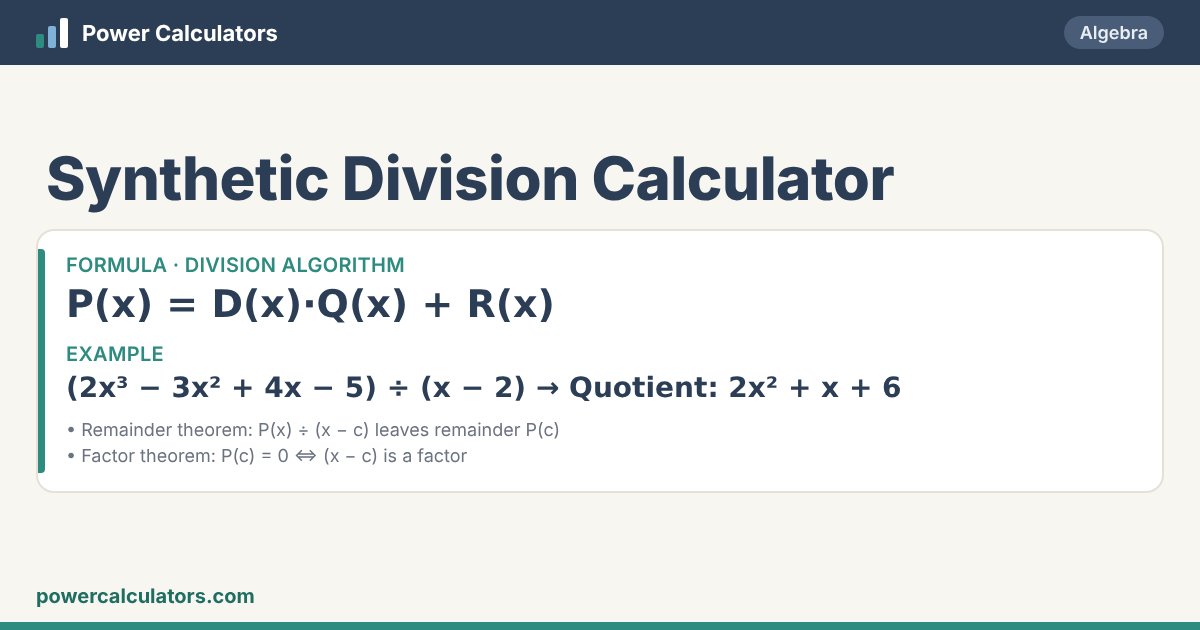
Synthetic Division Calculator: Division algorithm — P(x) = D(x)·Q(x) + R(x). Example: (2x³ − 3x² + 4x − 5) ÷ (x − 2) → Quotient: 2x² + x + 6
How the Synthetic Division Calculator works: Division algorithm — P(x) = D(x)·Q(x) + R(x)

Rate this calculator

Was it useful? A quick star rating helps others — and you can leave a comment too.
Rate it: ★ ★ ★ ★ ★

📘 About the Synthetic Division & Polynomial Long Division Calculator

Dividing polynomials works like long division of numbers: P(x) = divisor × quotient + remainder. Synthetic division is a fast shortcut when the divisor is x − c, using only the coefficients. It is used to factor polynomials, find roots and simplify rational expressions.

Enter the dividend and divisor. For a divisor x − c the calculator shows the synthetic table — bring down, multiply by c, add — and checks the remainder theorem P(c) = remainder (a remainder of 0 means x − c is a factor). Any other divisor uses polynomial long division.

🧮 Formula

Division algorithm
P(x) = D(x)·Q(x) + R(x)
Remainder theorem
P(x) ÷ (x − c) leaves remainder P(c)
Factor theorem
P(c) = 0 ⇔ (x − c) is a factor

✏️ Worked examples

(2x³ − 3x² + 4x − 5) ÷ (x − 2)

You enter
Dividend P(x)2x^3 - 3x^2 + 4x - 5
Divisorx - 2
You get
Quotient2x² + x + 6
Remainder7
Result(2x³ − 3x² + 4x − 5) ÷ (x − 2) = 2x² + x + 6 + 7/(x − 2)
Remainder theoremP(2) = 7

Quotient 2x² + x + 6, remainder 7.

(x⁴ − 1) ÷ (x² + 1)

You enter
Dividend P(x)x^4 - 1
Divisorx^2 + 1
You get
Quotientx² − 1
Remainder0
Result(x⁴ − 1) ÷ (x² + 1) = x² − 1

Quotient x² − 1, remainder 0.

🧭 How to use this calculator

What you enter

  • Dividend P(x)
  • Divisor

What you get

  • Quotient
  • Remainder
  • Result
  • Remainder theorem

❓ Frequently asked questions

How does synthetic division work?

Write the coefficients, bring down the first, multiply it by c, add to the next coefficient, and repeat. The last number is the remainder; the others are the quotient’s coefficients.

What if a power of x is missing?

Use a 0 for it: x³ − 1 has coefficients 1, 0, 0, −1. The calculator does this for you.

Can synthetic division divide by 2x − 1?

Divide by x − 1/2 and then divide the quotient by 2. The calculator handles any divisor with long division.