➗ Fraction Calculator (Add, Subtract, Multiply, Divide)

Add, subtract, multiply or divide fractions and mixed numbers. The answer is reduced to lowest terms and shown as a fraction, a mixed number and a decimal.

5.0 out of 5 (1 rating)

Enter details

Fractions
= ?

For a mixed number fill the whole-number box; leave it at 0 for a plain fraction.

  • First number — A fraction (3 over 4) or a mixed number (1 whole, 1 over 2). Leave the whole box at 0 for a plain fraction.
  • Operation
  • Second number

Log in or create a free account to save your inputs and results, so you don't have to enter them again next time.🔒 No spam, ever. We never sell or share your details, and you can delete your history or account at any time. Privacy policy

Fill in the details and click Calculate to see your results.

Formula at a glance

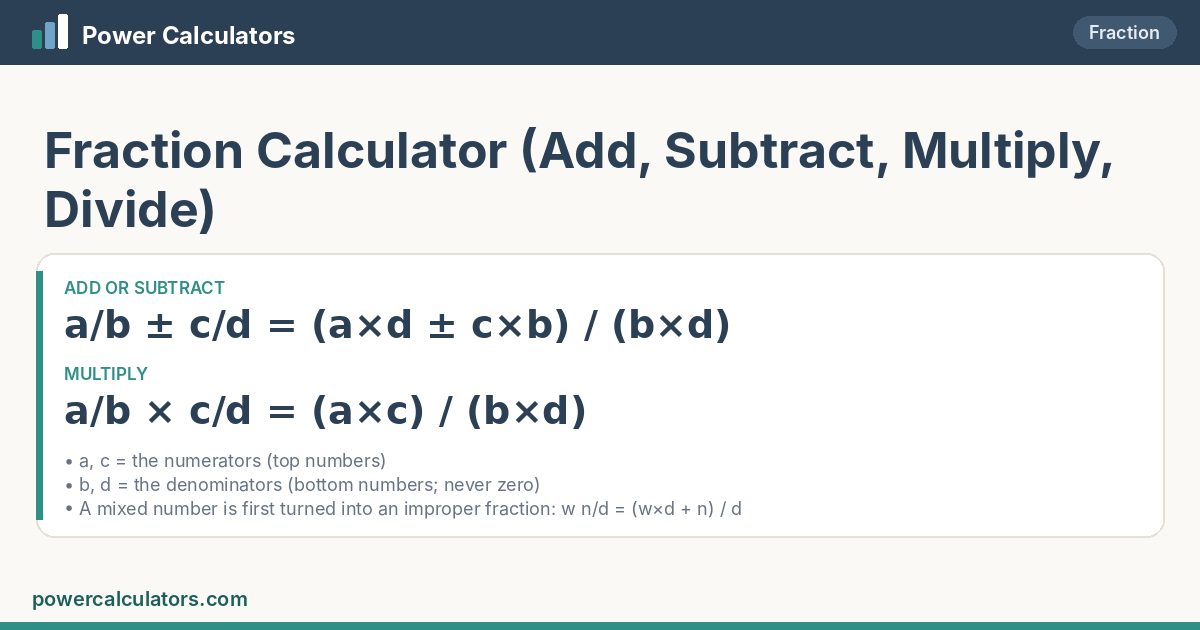
Fraction Calculator formula: a/b ± c/d = (a×d ± c×b) / (b×d); a/b × c/d = (a×c) / (b×d)
How the fraction calculator works: a/b ± c/d = (a×d ± c×b) / (b×d)

Rate this calculator

Was it useful? A quick star rating helps others — and you can leave a comment too.
Rate it: ★ ★ ★ ★ ★

📘 About the Fraction Calculator

A fraction describes part of a whole: the top number (numerator) says how many parts you have and the bottom number (denominator) says how many equal parts make up the whole. A mixed number combines a whole number with a fraction, such as 1 1/2.

Enter two fractions or mixed numbers, choose add, subtract, multiply or divide, and the calculator gives the answer already reduced to lowest terms — plus the same value as a mixed number and as a decimal.

🧮 Formula

Add or subtract
a/b ± c/d = (a×d ± c×b) / (b×d)
Multiply
a/b × c/d = (a×c) / (b×d)
Divide
a/b ÷ c/d = (a×d) / (b×c)
Reduce to lowest terms
divide top and bottom by their greatest common divisor

Where

  • a, c = the numerators (top numbers)
  • b, d = the denominators (bottom numbers; never zero)
  • A mixed number is first turned into an improper fraction: w n/d = (w×d + n) / d
Dividing by a fraction is the same as multiplying by its reciprocal, so you cannot divide by zero (0/anything).

✏️ Worked examples

1/2 + 1/3

You enter
First number1/2
Operation+ Add
Second number1/3
You get
Answer (lowest terms)5/6
As a mixed number5/6
As a decimal0.833333

The common denominator is 6, so 3/6 + 2/6 = 5/6.

2 1/4 − 3/4

You enter
First number2 1/4
Operation− Subtract
Second number3/4
You get
Answer (lowest terms)3/2
As a mixed number1 1/2
As a decimal1.5

2 1/4 is 9/4, and 9/4 − 3/4 = 6/4, which reduces to 3/2.

3/4 ÷ 3/8

You enter
First number3/4
Operation÷ Divide
Second number3/8
You get
Answer (lowest terms)2
As a mixed number2
As a decimal2

Flip the second fraction and multiply: 3/4 × 8/3 = 24/12 = 2.

🧭 How to use this calculator

What you enter

  • First numberA fraction (3 over 4) or a mixed number (1 whole, 1 over 2). Leave the whole box at 0 for a plain fraction.
  • Operation
  • Second number

What you get

  • Answer (lowest terms)
  • As a mixed number
  • As a decimal

❓ Frequently asked questions

How do I add fractions with different denominators?

Rewrite both over a common denominator (multiplying the two denominators always works), add the tops, then reduce. The calculator does all of this and gives the answer in lowest terms.

How do I enter a mixed number like 2 1/4?

Put 2 in the whole-number box and 1 over 4 in the fraction boxes. For a negative mixed number put the minus sign on the whole number, for example -2 1/4.

Why does it say there is no defined answer?

Dividing by a fraction whose numerator is zero (such as 3/4 ÷ 0/5) is dividing by zero, which has no answer.

Why is the answer different from my textbook?

Textbooks sometimes leave answers unreduced or as improper fractions. This calculator always reduces to lowest terms and also shows the mixed-number form so you can match either style.

How do you add fractions with different denominators?

Find the least common denominator, rewrite both fractions with it, add the numerators and simplify. 1/2 + 1/3 = 3/6 + 2/6 = 5/6.

How do you divide fractions?

Keep the first fraction, change ÷ to ×, and flip the second: 3/4 ÷ 3/8 = 3/4 × 8/3 = 2.

What people are saying
★★★★★
Anonymous · 03 Oct 2026