🔺 Isosceles Triangle Area Calculator

Calculate the area and height of an isosceles triangle from its two equal sides and base. Includes triangle validity checking and a worked example.

No ratings yet — be the first

Enter details

Isosceles triangle
A = b/4√(4a² - b²)
equal sidesa =,baseb =
  • Equal Side (cm) — Enter the length of either of the two equal sides.
  • Base (cm)

Log in or create a free account to save your inputs and results, so you don't have to enter them again next time.🔒 No spam, ever. We never sell or share your details, and you can delete your history or account at any time. Privacy policy

Fill in the details and click Calculate to see your results.

Formula at a glance

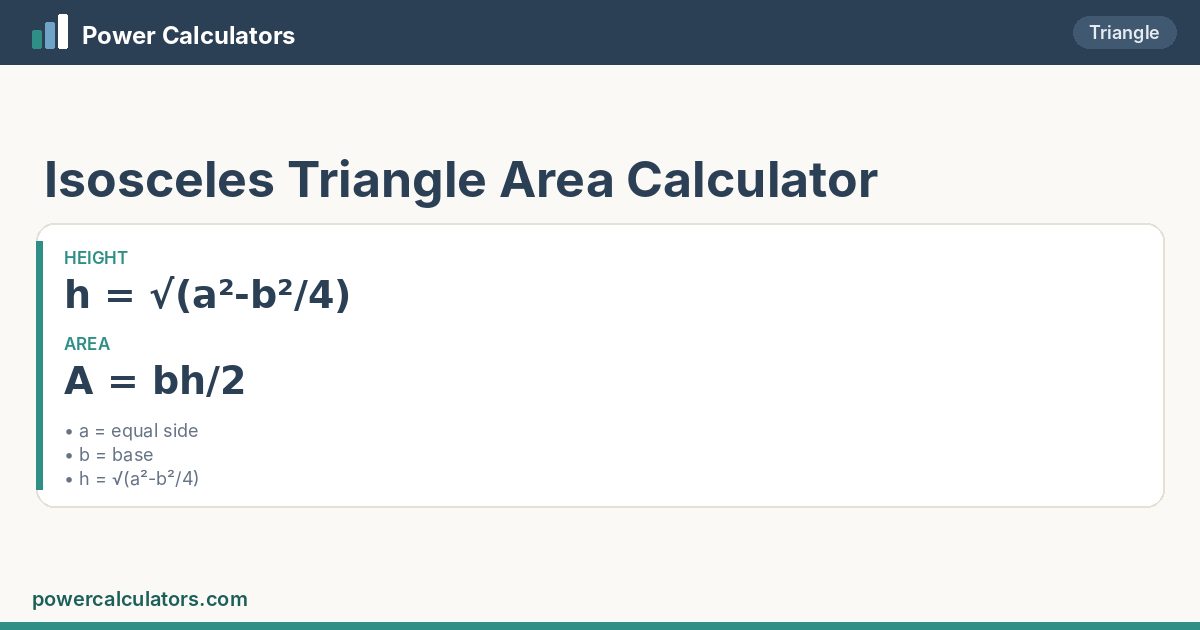
Isosceles Triangle formula: h = √(a²-b²/4); A = bh/2
How the isosceles triangle works: h = √(a²-b²/4)

Rate this calculator

Was it useful? A quick star rating helps others — and you can leave a comment too.
Rate it: ★ ★ ★ ★ ★

📘 About the Isosceles Triangle Area Calculator

An isosceles triangle has two equal sides.

When the altitude is drawn from the vertex between the equal sides, it bisects the base.

The height is found from the equal side and half the base, then area is one half base times height.

🧮 Formula

Height
h = √(a²-b²/4)
Area
A = bh/2

Where

  • a = equal side
  • b = base
  • h = √(a²-b²/4)
  • A = bh/2
The equal side must be longer than half the base for a non-degenerate triangle.

✏️ Worked example

Equal sides 5 cm and base 6 cm

You enter
Equal Side5 cm
Base6 cm
You get
Triangle Area12
Height4

The height is 4 cm and the area is 12 square centimetres.

🧭 How to use this calculator

What you enter

  • Equal Side (cm)Enter the length of either of the two equal sides.
  • Base (cm)

What you get

  • Triangle Area
  • Height

💡 Validity

  • Both entered lengths must be positive.
  • The sum of the two equal sides must be greater than the base.
  • A base equal to twice the equal side produces a degenerate case with zero height.

❓ Frequently asked questions

What is the formula for an isosceles triangle area?

If a is the equal side and b is the base, area is b times the square root of a squared minus b squared divided by 4, all divided by 2.

Why is the base divided by 2?

The altitude of an isosceles triangle bisects the base into two equal halves.

Are the two equal sides the base?

No. The base is the third side, opposite the vertex between the equal sides.

What happens when the equal sides are 5 and the base is 6?

The height is 4 cm and the area is 12 square centimetres.

How do you find the area of an isosceles triangle?

Find the height h = √(a² − (b/2)²) from the equal side a and base b, then area = ½ × b × h. For a = 5, b = 6: h = 4, area = 12.