🤝 Salary Offer Comparison Calculator: Compare Two Job Offers

A higher CTC is not always a better offer. Compare what each job is really worth to you.

No ratings yet — be the first

Enter details

Log in or create a free account to save your inputs and results, so you don't have to enter them again next time.🔒 No spam, ever. We never sell or share your details, and you can delete your history or account at any time. Privacy policy

Fill in the details and click Calculate to see your results.

Formula at a glance

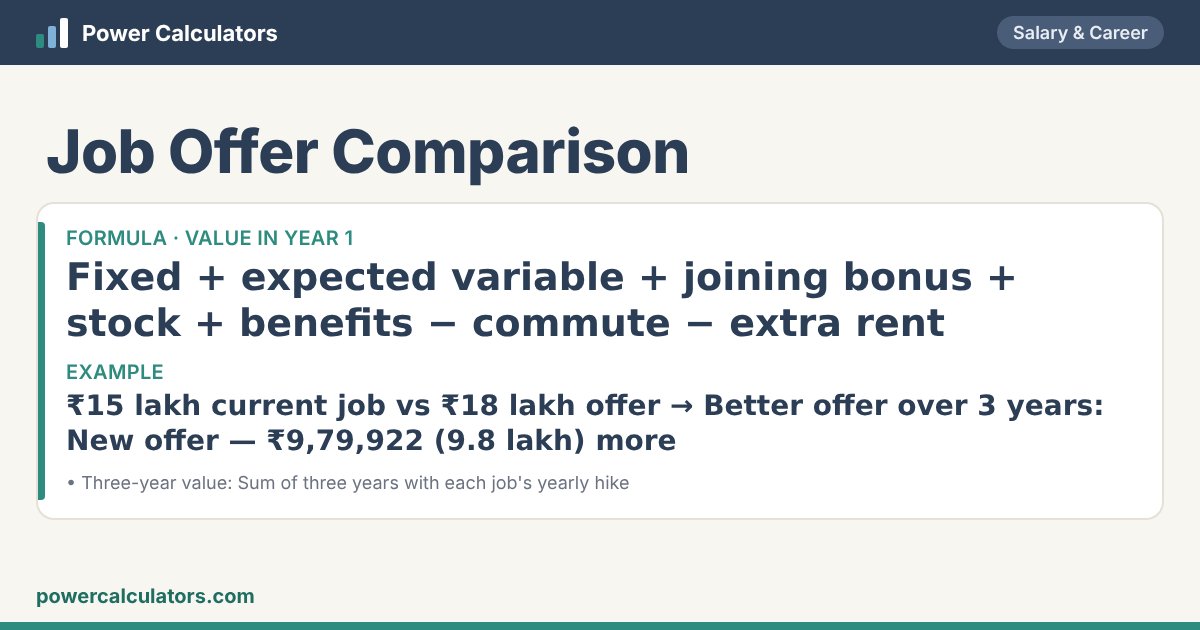
Job Offer Comparison: Value in year 1 — Fixed + expected variable + joining bonus + stock + benefits − commute − extra rent. Example: ₹15 lakh current job vs ₹18 lakh offer → Better offer over 3 years: New offer — ₹9,79,922 (9.8 lakh) more
How the Job Offer Comparison works: Value in year 1 — Fixed + expected variable + joining bonus + stock + benefits − commute − extra rent

📱 Also in our Android app

This calculator is also in our free app. Sign in with the same account to keep your history in sync.

  • Financial CalculatorEMI, SIP, PPF, NPS, post office schemes and government-employee calculatorsGet it on Google Play

Rate this calculator

Was it useful? A quick star rating helps others — and you can leave a comment too.
Rate it: ★ ★ ★ ★ ★

📘 About the Salary Offer Comparison Calculator

CTC numbers hide a lot: variable pay that may not be paid in full, joining bonuses that come once, stock that vests over years, and costs like a longer commute or moving to a pricier city. Two offers with the same CTC can differ by lakhs in what you keep.

Enter both offers. The calculator counts variable pay at the payout you expect, adds benefits and stock, subtracts commute and extra rent, and compares the value in the first year and over three years with each job's expected hikes. For India it also estimates monthly in-hand pay under the new tax regime.

🧮 Formula

Value in year 1
Fixed + expected variable + joining bonus + stock + benefits − commute − extra rent
Three-year value
Sum of three years with each job's yearly hike

✏️ Worked examples

₹15 lakh current job vs ₹18 lakh offer

You enter
Currency₹ Indian rupee
Offer A nameCurrent job
Offer A: fixed pay a year1500000
Offer A: variable / bonus10 % of fixed
Offer A: expected payout of variable80%
Offer A: joining bonus0
Offer A: stock (ESOP/RSU) value a year0
Offer A: benefits a year (insurance, meals, allowances)50000
Offer A: commute cost a month3000
Offer A: expected yearly hike8%
Offer A: extra rent a month if you move0
Offer B nameNew offer
Offer B: fixed pay a year1800000
Offer B: variable / bonus15 % of fixed
Offer B: expected payout of variable70%
Offer B: joining bonus100000
Offer B: stock (ESOP/RSU) value a year0
Offer B: benefits a year (insurance, meals, allowances)40000
Offer B: commute cost a month6000
Offer B: expected yearly hike8%
Offer B: extra rent a month if you move5000
Show in-hand pay forIndia (new tax regime)
You get
Better offer over 3 yearsNew offer — ₹9,79,922 (9.8 lakh) more
First-year valueCurrent job: ₹16,34,000 (16.34 lakh) · New offer: ₹19,97,000 (19.97 lakh)
Three-year valueCurrent job: ₹53,01,168 (53.01 lakh) · New offer: ₹62,81,090 (62.81 lakh)
Monthly in-hand from fixed pay (approx., new tax regime)Current job: ₹1,09,782 · New offer: ₹1,28,163

New offer — ₹9,79,922 (9.8 lakh) more.

Startup with stock vs stable company

You enter
Currency₹ Indian rupee
Offer A nameStable company
Offer A: fixed pay a year2000000
Offer A: variable / bonus10 % of fixed
Offer A: expected payout of variable90%
Offer A: joining bonus0
Offer A: stock (ESOP/RSU) value a year0
Offer A: benefits a year (insurance, meals, allowances)80000
Offer A: commute cost a month4000
Offer A: expected yearly hike9%
Offer A: extra rent a month if you move0
Offer B nameStartup
Offer B: fixed pay a year1800000
Offer B: variable / bonus0 % of fixed
Offer B: expected payout of variable0%
Offer B: joining bonus0
Offer B: stock (ESOP/RSU) value a year300000
Offer B: benefits a year (insurance, meals, allowances)30000
Offer B: commute cost a month2000
Offer B: expected yearly hike12%
Offer B: extra rent a month if you move0
Show in-hand pay forIndia (new tax regime)
You get
Better offer over 3 yearsStable company — ₹2,50,338 (2.5 lakh) more
First-year valueStable company: ₹22,12,000 (22.12 lakh) · Startup: ₹21,06,000 (21.06 lakh)
Three-year valueStable company: ₹72,42,258 (72.42 lakh) · Startup: ₹69,91,920 (69.92 lakh)
Monthly in-hand from fixed pay (approx., new tax regime)Stable company: ₹1,40,344 · Startup: ₹1,29,933

Stable company — ₹2,50,338 (2.5 lakh) more.

🧭 How to use this calculator

What you enter

  • Currency
  • Offer A name
  • Offer A: fixed pay a year
  • Offer A: variable / bonus (% of fixed)
  • Offer A: expected payout of variable (%)
  • Offer A: joining bonus
  • Offer A: stock (ESOP/RSU) value a year
  • Offer A: benefits a year (insurance, meals, allowances)
  • Offer A: commute cost a month
  • Offer A: expected yearly hike (%)
  • Offer A: extra rent a month if you move
  • Offer B name
  • Offer B: fixed pay a year
  • Offer B: variable / bonus (% of fixed)
  • Offer B: expected payout of variable (%)
  • Offer B: joining bonus
  • Offer B: stock (ESOP/RSU) value a year
  • Offer B: benefits a year (insurance, meals, allowances)
  • Offer B: commute cost a month
  • Offer B: expected yearly hike (%)
  • Offer B: extra rent a month if you move
  • Show in-hand pay for

What you get

  • Better offer over 3 years
  • First-year value
  • Three-year value
  • Monthly in-hand from fixed pay (approx., new tax regime)

💡 Questions to ask HR

  • How much of the variable pay was paid last year?
  • What is the employer PF and gratuity counted in the CTC?
  • When do stock options vest, and is there a cliff?
  • Must the joining bonus be repaid if I leave within a year?

❓ Frequently asked questions

How much hike should I ask for when switching jobs?

In India a switch commonly brings 20–40%. Compare the fixed part and the in-hand pay, not just CTC.

How do I value ESOPs?

Startup ESOPs may be worth nothing or a lot. Use the yearly vesting value at the latest funding price, then discount it by half or more for risk and illiquidity.

What else should I weigh besides money?

The role, learning, manager, team, job security, hours, work-from-home days, notice period and the company's growth.