🌃 Light Pollution Calculator: Bortle Class, SQM and Limiting Magnitude

How much of the night sky has your city taken away?

No ratings yet — be the first

Enter details

SQM readings run from about 16 in a city centre to 22 at the darkest sites.

Log in or create a free account to save your inputs and results, so you don't have to enter them again next time.🔒 No spam, ever. We never sell or share your details, and you can delete your history or account at any time. Privacy policy

Fill in the details and click Calculate to see your results.

Formula at a glance

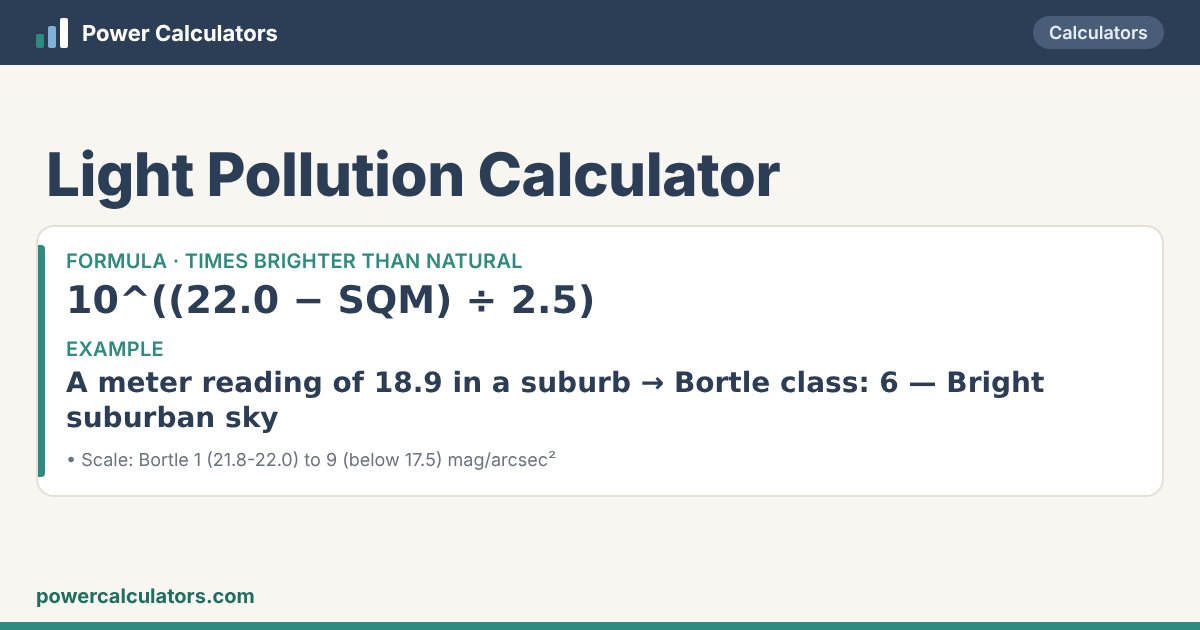
Light Pollution Calculator: Times brighter than natural — 10^((22.0 − SQM) ÷ 2.5). Example: A meter reading of 18.9 in a suburb → Bortle class: 6 — Bright suburban sky
How the Light Pollution Calculator works: Times brighter than natural — 10^((22.0 − SQM) ÷ 2.5)

Rate this calculator

Was it useful? A quick star rating helps others — and you can leave a comment too.
Rate it: ★ ★ ★ ★ ★

📘 About the Light Pollution Calculator

The Bortle scale grades the night sky from 1, an excellent dark-sky site where the Milky Way casts a faint shadow, to 9, an inner-city sky where only the Moon, the planets and a handful of stars survive. A sky-quality meter reports the same thing numerically, in magnitudes per square arcsecond, where larger means darker and five magnitudes is a hundredfold change in brightness.

A natural, unpolluted sky is about 22.0 mag/arcsec². A bright suburban sky at 18.9 is roughly seventeen times brighter than that; an inner-city sky can be a hundred times brighter. What you lose is not the bright stars, which survive almost anywhere, but everything faint — the Milky Way goes first, then the fainter constellations, then most of what is left.

The conversions are approximate by nature. Bortle's own limiting magnitudes are widely held to be optimistic — 6.0 to 6.5 is more realistic at a good dark site than the 7.6 to 8.0 his class 1 quotes — and your own reading depends on the Moon, haze, altitude and how dark-adapted your eyes are. Take a meter reading at the zenith on a moonless night, well after twilight.

🧮 Formula

Times brighter than natural
10^((22.0 − SQM) ÷ 2.5)
Scale
Bortle 1 (21.8-22.0) to 9 (below 17.5) mag/arcsec²

✏️ Worked examples

A meter reading of 18.9 in a suburb

You enter
I know theSky brightness in mag/arcsec² (SQM reading)
Value18.9
You get
Bortle class6 — Bright suburban sky
Sky brightness18.9 mag/arcsec² (your reading)
Naked-eye limiting magnitude5.1 to 5.5 — the faintest star you should be able to see
Compared with a natural sky17.4× brighter than an unpolluted sky of 22.0 mag/arcsec²
The Milky Waywashed out — visible only near the zenith, if at all
Stars you can seea few hundred

6 — Bright suburban sky, 17.4× brighter than an unpolluted sky of 22.0 mag/arcsec².

Someone says their sky is Bortle 4

You enter
I know theBortle class, 1 to 9
Value4
You get
Bortle class4 — Brighter rural sky
Sky brightness21.05 mag/arcsec² — the middle of this class
Naked-eye limiting magnitude6.3 to 6.5 — the faintest star you should be able to see
Compared with a natural sky2.4× brighter than an unpolluted sky of 22.0 mag/arcsec²
The Milky Wayclearly visible but losing detail
Stars you can seea thousand or two

That is about 21.05 mag/arcsec² — the middle of this class, with 6.3 to 6.5 — the faintest star you should be able to see.

I can just see magnitude 5.0 stars

You enter
I know theFaintest star I can see (limiting magnitude)
Value5.0
You get
Bortle class7 — Suburban / urban transition
Sky brightness18.25 mag/arcsec² — the middle of this class
Naked-eye limiting magnitude4.6 to 5 — the faintest star you should be able to see
Compared with a natural sky31.6× brighter than an unpolluted sky of 22.0 mag/arcsec²
The Milky Wayinvisible
Stars you can seeunder a hundred — the brightest constellation stars

That is Bortle 7 — Suburban / urban transition, where the Milky Way is invisible.

🧭 How to use this calculator

What you enter

  • I know the
  • ValueSQM readings run from about 16 in a city centre to 22 at the darkest sites.

What you get

  • Bortle class
  • Sky brightness
  • Naked-eye limiting magnitude
  • Compared with a natural sky
  • The Milky Way
  • Stars you can see

💡 The Bortle classes at a glance

  • Class 1-2 (21.6-22.0) — truly dark; zodiacal light obvious, Milky Way highly structured.
  • Class 3 (21.3-21.6) — rural; slight glow on the horizon, Milky Way still striking.
  • Class 4-4.5 (20.3-21.3) — brighter rural to transition; light domes in several directions.
  • Class 5 (19.25-20.3) — suburban; Milky Way washed out and visible only overhead.
  • Class 6-7 (18.0-19.25) — bright suburban to urban fringe; Milky Way all but gone.
  • Class 8-9 (below 18.0) — city and inner city; only the brightest stars and planets remain.

❓ Frequently asked questions

What is the Bortle scale?

A nine-point grading of night-sky darkness published by John Bortle in 2001, from class 1 (an excellent dark-sky site) to class 9 (inner city).

What SQM reading is a dark sky?

About 21.3 and above is rural, 21.6 and above is a genuinely dark site, and 21.8-22.0 is as dark as it gets on Earth.

How much brighter is a city sky than a natural one?

A bright suburban sky at 18.9 mag/arcsec² is about 17 times brighter than natural; an inner-city sky can be a hundred times brighter.

What is naked-eye limiting magnitude?

The faintest star you can see without optical aid. It is the oldest way of grading a sky and is still useful, though it depends heavily on eyesight and dark adaptation.

Can light pollution be reduced?

Yes, and unusually among pollutants it stops the moment the source does. Shielded, warm-coloured, downward-facing lighting at the lowest useful brightness recovers most of it.

Does light pollution matter beyond astronomy?

It disrupts the night-time behaviour of insects, birds, bats and turtles, and skyglow is simply wasted light — energy paid for and aimed at nothing.