🏆 NPS Calculator for Govt Employees: Retirement Corpus & Pension

How big will your NPS pot be when you retire? Enter your pay level, age and expected return to see your retirement corpus, the lump sum you can withdraw and the monthly pension from the annuity.

No ratings yet — be the first

Enter details

Fill in the details and click Calculate to see your results.

This calculator is independent and unofficial — not affiliated with, endorsed by, or a representative of the Government of India or any government department. Figures are estimates for informational purposes; verify official figures before making decisions.

Formula at a glance

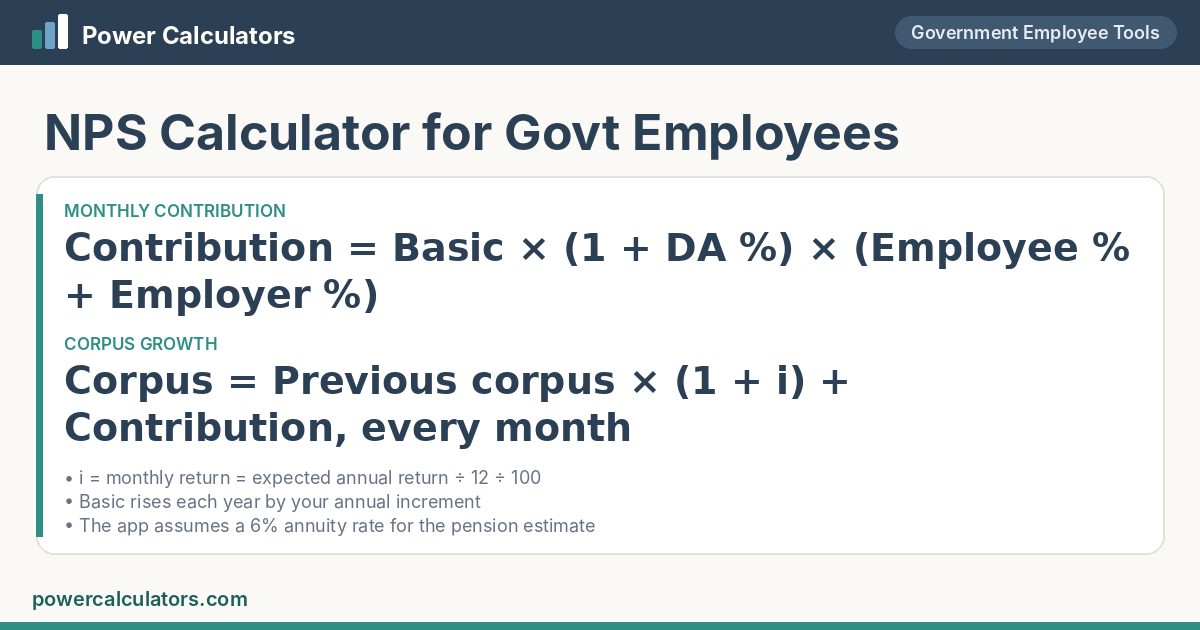
NPS Calculator formula: Contribution = Basic × (1 + DA %) × (Employee % + Employer %); Corpus = Previous corpus × (1 + i) + Contribution, every month
How the nps calculator works: Contribution = Basic × (1 + DA %) × (Employee % + Employer %)

📱 Also in our Android apps

This calculator is in each of these free apps. Sign in with the same account to keep your history in sync.

  • Financial CalculatorEMI, SIP, PPF, NPS, post office schemes and government-employee calculatorsGet it on Google Play
  • Govt Employee CalculatorSalary, DA, pension and income tax for government employeesGet it on Google Play

Rate this calculator

Was it useful? A quick star rating helps others — and you can leave a comment too.
Rate it: ★ ★ ★ ★ ★

📘 About the NPS Corpus & Pension Calculator

Under the National Pension System (NPS) you contribute 10% of basic + DA every month and the Government adds 14%. The money is invested and grows until you retire.

This calculator projects that growth year by year — with your annual increments and the return you expect — to estimate your retirement corpus at 60. At retirement you can take 60% as a tax-free lump sum; at least 40% must buy an annuity, which pays your monthly pension.

Returns are not guaranteed: try a lower and a higher return to see a range. Compare with the Unified Pension Scheme (UPS) in the NPS vs UPS vs OPS calculator.

🧮 Formula

Monthly contribution
Contribution = Basic × (1 + DA %) × (Employee % + Employer %)
Corpus growth
Corpus = Previous corpus × (1 + i) + Contribution, every month
At retirement
Lump sum = 60% of corpus; Annuity corpus = 40%
Monthly pension
Pension ≈ Annuity corpus × annuity rate ÷ 12

Where

  • i = monthly return = expected annual return ÷ 12 ÷ 100
  • Basic rises each year by your annual increment
  • The app assumes a 6% annuity rate for the pension estimate
The 60/40 split and annuity rate are assumptions and rules can differ between schemes and change over time.

✏️ Worked examples

Level 7, age 30, 10% return

You enter
Pay LevelLevel 7
Current Stage0
Current DA %58%
Employee Contribution10%
Government Contribution14%
Assumed Annual Increment3%
Expected Annual Return10%
Current Age30 yrs
Retirement Age60 yrs
Current NPS Corpus (if any)₹0
You get
Projected Corpus at Retirement₹4,98,54,276.32
Lump Sum (60%)₹2,99,12,565.79
Annuity Corpus (40%)₹1,99,41,710.53
Est. Monthly Pension₹99,708.55

₹4,98,54,276.32.

Age 30 to 60, basic ₹56,100, 10% + 14% contribution, 8% return

You enter
Basic pay₹56,100 a month
Dearness allowance60%
Employee + employer contribution10% + 14%
Expected return8% a year
Annual increment3%
Age30 to 60
You get
Corpus at retirement₹43,056,661.87
Total contributions₹12,298,663.62
Lump sum (60%)₹25,833,997.12
Annuity corpus (40%)₹17,222,664.75
Estimated monthly pension₹86,113.32

These are projections under stated assumptions, not guaranteed values.

❓ Frequently asked questions

How much will my NPS corpus be at retirement?

It depends on your pay, years of service and returns. For example, a Level 7 employee starting at 30 with 10% returns can build a corpus of well over ₹1.5 crore by 60 — enter your own details for an estimate.

How much NPS can I withdraw at 60?

Up to 60% of the corpus as a tax-free lump sum; the remaining 40% (or more) must be used to buy an annuity that pays a monthly pension.

How is the NPS pension calculated?

The annuity amount × the annuity rate ÷ 12. At about 6% a year, every ₹10 lakh in the annuity pays roughly ₹5,000 a month.