⚖️ NPS vs UPS vs OPS Pension Comparison

Compare your pension at retirement under NPS, UPS and the Old Pension Scheme from your basic pay, age and expected returns.

No ratings yet — be the first

Enter details

Increments, promotions and DA together; 6–8% is typical.

Log in or create a free account to save your inputs and results, so you don't have to enter them again next time.🔒 No spam, ever. We never sell or share your details, and you can delete your history or account at any time. Privacy policy

Fill in the details and click Calculate to see your results.

This calculator is independent and unofficial — not affiliated with, endorsed by, or a representative of the Government of India or any government department. Figures are estimates for informational purposes; verify official figures before making decisions.

Formula at a glance

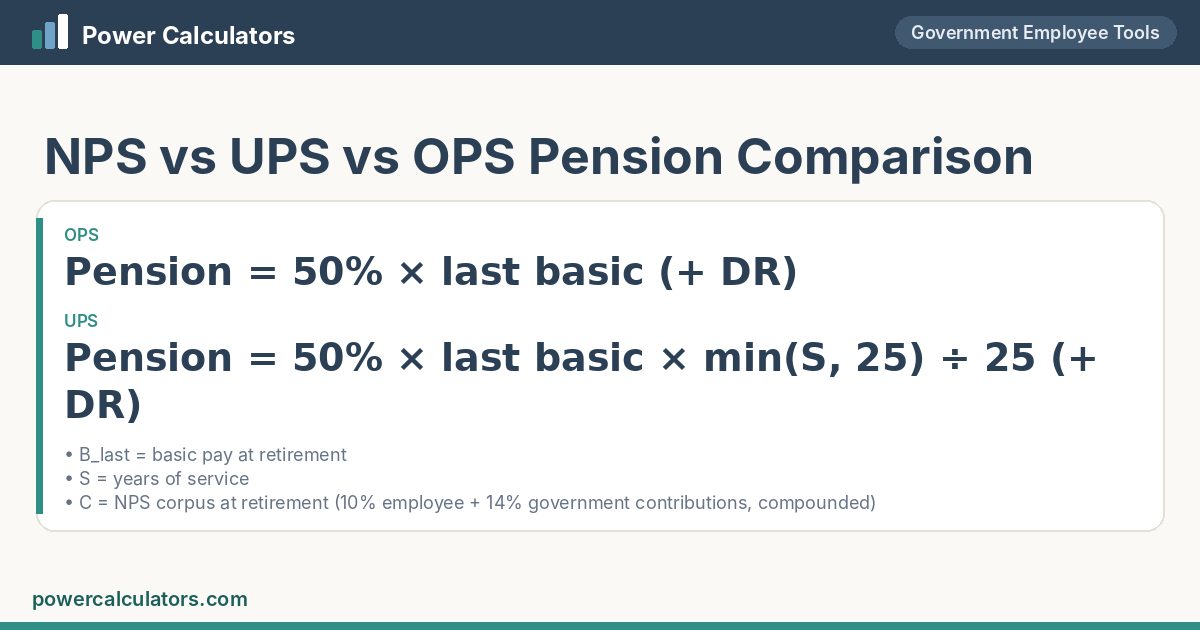
NPS vs UPS vs OPS formula: Pension = 50% × last basic (+ DR); Pension = 50% × last basic × min(S, 25) ÷ 25 (+ DR)
How the nps vs ups vs ops works: Pension = 50% × last basic (+ DR)

📱 Also in our Android app

This calculator is also in our free app. Sign in with the same account to keep your history in sync.

  • Govt Employee CalculatorSalary, DA, pension and income tax for government employeesGet it on Google Play

Rate this calculator

Was it useful? A quick star rating helps others — and you can leave a comment too.
Rate it: ★ ★ ★ ★ ★

📘 About the NPS vs UPS vs OPS Calculator

Should you stay in NPS or move to the Unified Pension Scheme? This calculator estimates your monthly pension at retirement under all three schemes from your current basic pay, age and service, with assumptions you can change.

OPS and UPS give a defined pension that rises with dearness relief; NPS depends on market returns and the annuity rate, but gives a bigger tax-free lump sum. The comparison is only an estimate: promotions, pay commissions and returns will change the numbers.

🧮 Formula

OPS
Pension = 50% × last basic (+ DR)
UPS
Pension = 50% × last basic × min(S, 25) ÷ 25 (+ DR)
NPS
Annuity = 40% × corpus × annuity rate ÷ 12

Where

  • B_last = basic pay at retirement
  • S = years of service
  • C = NPS corpus at retirement (10% employee + 14% government contributions, compounded)
  • r_a = annuity rate
OPS is not open to employees who joined on or after 1 January 2004 (except the armed forces); it is shown for comparison.

✏️ Worked examples

Age 30, Level 7 entry pay

You enter
Current Basic Pay44,900 ₹/month
Current Age30 years
Retirement Age60 years
Service Already Completed2 years
Current DA %60%
Expected Yearly Growth in Pay (basic + DA)6%
Expected NPS Return9 % a year
Annuity Rate6 % a year
DA % at Retirement (assumed)50%
Current NPS Corpus₹0
You get
OPS Pension at Retirement (with DR)₹2,06,306 a month
UPS Pension at Retirement (with DR)₹2,06,306 a month
NPS Annuity Pension at Retirement₹1,14,655 a month
NPS Lump Sum (60% of corpus, tax-free)₹3,43,96,627
UPS Lump Sum₹26,40,719
NPS Corpus at Retirement₹5,73,27,711
Basic Pay at Retirement (estimated)₹2,75,075
Highest Monthly PensionUPS (32 years of service)

Estimated pension: UPS ₹2,06,306 a month vs NPS ₹1,14,655 a month a month.

Age 45, ₹80,000 basic

You enter
Current Basic Pay80,000 ₹/month
Current Age45 years
Retirement Age60 years
Service Already Completed15 years
Current DA %60%
Expected Yearly Growth in Pay (basic + DA)6%
Expected NPS Return9 % a year
Annuity Rate6 % a year
DA % at Retirement (assumed)50%
Current NPS Corpus₹2,500,000
You get
OPS Pension at Retirement (with DR)₹1,53,380 a month
UPS Pension at Retirement (with DR)₹1,53,380 a month
NPS Annuity Pension at Retirement₹51,957 a month
NPS Lump Sum (60% of corpus, tax-free)₹1,55,87,003
UPS Lump Sum₹18,40,557
NPS Corpus at Retirement₹2,59,78,339
Basic Pay at Retirement (estimated)₹2,04,506
Highest Monthly PensionUPS (30 years of service)

With 15 years left, UPS gives ₹1,53,380 a month and NPS ₹51,957 a month a month.

🧭 How to use this calculator

What you enter

  • Current Basic Pay (₹/month)
  • Current Age (years)
  • Retirement Age (years)
  • Service Already Completed (years)
  • Current DA % (%)
  • Expected Yearly Growth in Pay (basic + DA) (%)Increments, promotions and DA together; 6–8% is typical.
  • Expected NPS Return (% a year)
  • Annuity Rate (% a year)
  • DA % at Retirement (assumed) (%)
  • Current NPS Corpus (₹)

What you get

  • OPS Pension at Retirement (with DR)
  • UPS Pension at Retirement (with DR)
  • NPS Annuity Pension at Retirement
  • NPS Lump Sum (60% of corpus, tax-free)
  • UPS Lump Sum
  • NPS Corpus at Retirement
  • Basic Pay at Retirement (estimated)
  • Highest Monthly Pension

💡 Which pension scheme is better?

  • UPS suits most people who will complete 25 years: the pension is assured and rises with DR.
  • NPS can win for young employees with high market returns, and gives a larger lump sum.
  • Short service (under 10 years) gets no assured pension under UPS.

❓ Frequently asked questions

Which is better, NPS or UPS?

For long service, UPS usually gives a higher and inflation-protected pension. NPS can give more if markets do well, and its lump sum is larger.

Can I get OPS if I joined after 2004?

No. OPS is closed to central government employees who joined on or after 1 January 2004, except the armed forces.

How much does the government contribute?

14% of basic + DA under NPS and 18.5% under UPS; employees contribute 10% in both.

Is the NPS pension inflation-linked?

No. An NPS annuity is usually fixed for life; OPS and UPS pensions rise with dearness relief.