🔷 Prism Calculator: Triangular & Hexagonal Prism Volume and Surface Area

Choose the base and enter its sides and the prism's length.

No ratings yet — be the first

Enter details

Log in or create a free account to save your inputs and results, so you don't have to enter them again next time.🔒 No spam, ever. We never sell or share your details, and you can delete your history or account at any time. Privacy policy

Fill in the details and click Calculate to see your results.

Formula at a glance

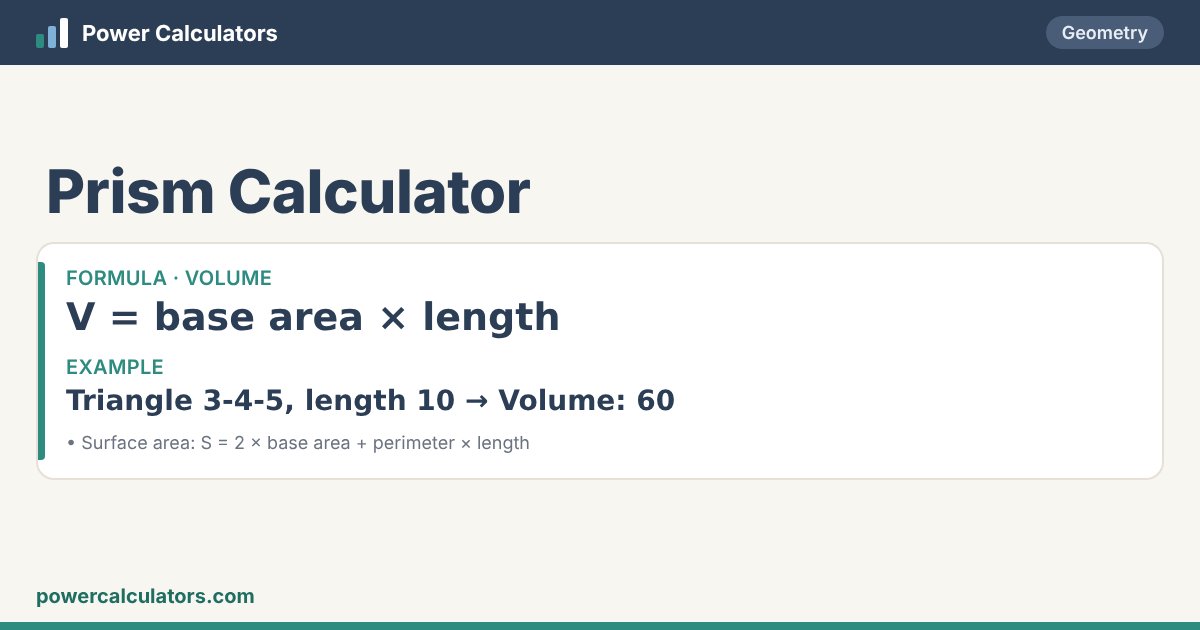
Prism Calculator: Volume — V = base area × length. Example: Triangle 3-4-5, length 10 → Volume: 60
How the Prism Calculator works: Volume — V = base area × length

Rate this calculator

Was it useful? A quick star rating helps others — and you can leave a comment too.
Rate it: ★ ★ ★ ★ ★

📘 About the Prism Calculator

A prism has two identical parallel bases joined by rectangular faces. Its volume is simply the base area times the length; the surface area is the two bases plus the perimeter times the length.

Triangular prisms appear in tents, roofs and glass prisms that split light; hexagonal prisms in pencils, nuts and honeycomb cells. For a cuboid or cylinder, use those calculators.

🧮 Formula

Volume
V = base area × length
Surface area
S = 2 × base area + perimeter × length

✏️ Worked examples

Triangle 3-4-5, length 10

You enter
Base shapeTriangle (any three sides)
Base side a3
Base side b (triangle)4
Base side c (triangle)5
Length of the prism10
You get
Volume60
Base area6
Lateral surface area120
Total surface area132
Base perimeter12

The volume is 60.

Hexagonal prism, side 2, length 15

You enter
Base shapeRegular polygon
Base side a2
Number of sides (polygon)6
Length of the prism15
You get
Volume155.884573
Base area10.392305
Lateral surface area180
Total surface area200.78461
Base perimeter12

The volume is 155.884573.

🧭 How to use this calculator

What you enter

  • Base shape
  • Base side a
  • Base side b (triangle)
  • Base side c (triangle)
  • Number of sides (polygon)
  • Length of the prism

What you get

  • Volume
  • Base area
  • Lateral surface area
  • Total surface area
  • Base perimeter

❓ Frequently asked questions

How do you find the volume of a triangular prism?

Find the triangle's area (½ × base × height, or Heron's formula from three sides) and multiply by the length.