🎾 Tennis Stats Calculator: Serve and Break Point Percentages

The second serve is where matches are actually decided.

5.0 out of 5 (1 rating)

Enter details

Every service point starts with a first serve, so this is also your first-serve attempts.

Log in or create a free account to save your inputs and results, so you don't have to enter them again next time.🔒 No spam, ever. We never sell or share your details, and you can delete your history or account at any time. Privacy policy

Fill in the details and click Calculate to see your results.

Formula at a glance

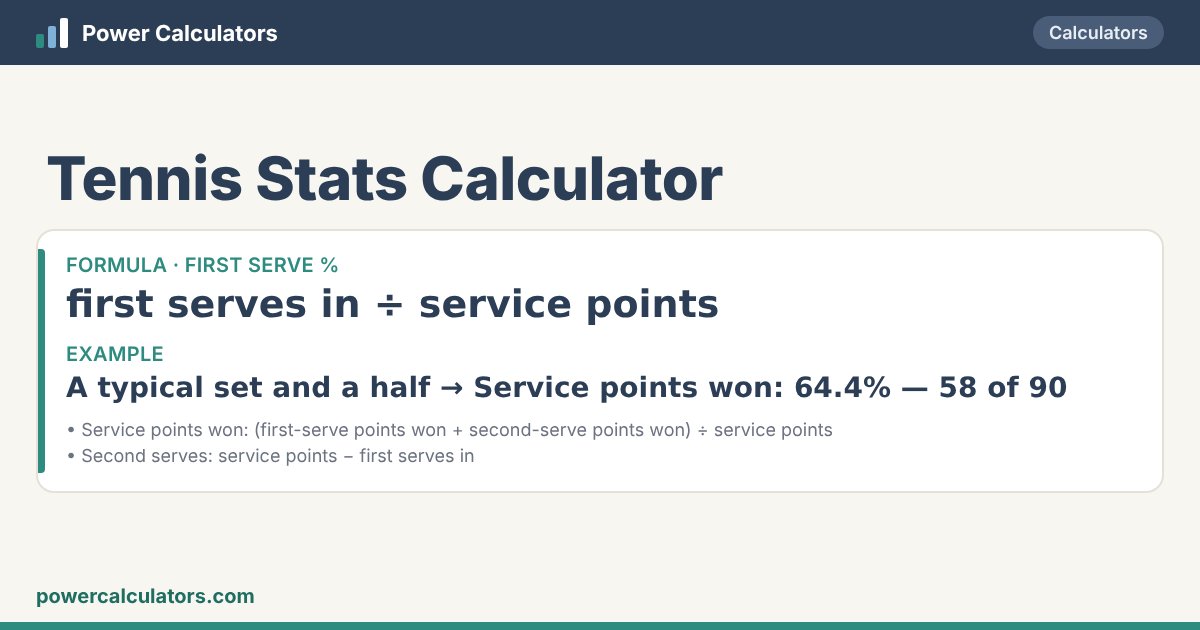
Tennis Stats Calculator: First serve % — first serves in ÷ service points. Example: A typical set and a half → Service points won: 64.4% — 58 of 90
How the Tennis Stats Calculator works: First serve % — first serves in ÷ service points

Rate this calculator

Was it useful? A quick star rating helps others — and you can leave a comment too.
Rate it: ★ ★ ★ ★ ★

📘 About the Tennis Stats Calculator

Service points won is the headline: first-serve points won plus second-serve points won, over all service points. Everything else on a match sheet is a component of it, and holding serve comfortably is what a good server actually produces.

First serve percentage around 60-65% is usually the sweet spot. Pushing it much higher normally means taking pace off and winning fewer of those points; pushing it lower means playing too many second serves, which is the expensive outcome. The percentage on its own is not a goal.

Points won behind the second serve is the number that separates levels most sharply. Top professionals win just over half of them, club players far fewer, because every weak second serve hands the initiative to the returner. Break point conversion is the noisiest statistic here — a player can create more chances and still lose the set — so read it over a season rather than a single match.

🧮 Formula

First serve %
first serves in ÷ service points
Service points won
(first-serve points won + second-serve points won) ÷ service points
Second serves
service points − first serves in

✏️ Worked examples

A typical set and a half

You enter
Service points played90
First serves in55
Points won behind the first serve40
Points won behind the second serve18
Double faults4
Break points converted (optional)3
Break points you had (optional)8
You get
Service points won64.4% — 58 of 90
First serve percentage61.1% — about right
Won behind the first serve72.7%
Won behind the second serve51.4% — the number that separates levels
Double faults4 · 11.4% of second serves
Break points converted3 of 8 — 37.5%

64.4% — 58 of 90, and 51.4% — the number that separates levels.

A big server having a good day

You enter
Service points played110
First serves in75
Points won behind the first serve62
Points won behind the second serve20
Double faults2
Break points converted (optional)4
Break points you had (optional)6
You get
Service points won74.5% — 82 of 110
First serve percentage68.2% — high
Won behind the first serve82.7%
Won behind the second serve57.1% — the number that separates levels
Double faults2 · 5.7% of second serves
Break points converted4 of 6 — 66.7%

74.5% — 82 of 110, with 68.2% — high.

Struggling on serve

You enter
Service points played80
First serves in38
Points won behind the first serve24
Points won behind the second serve15
Double faults9
Break points converted (optional)1
Break points you had (optional)5
You get
Service points won48.8% — 39 of 80
First serve percentage47.5% — low: either the first serve is too ambitious or the toss is inconsistent
Won behind the first serve63.2%
Won behind the second serve35.7% — the number that separates levels
Double faults9 · 21.4% of second serves
Break points converted1 of 5 — 20%

48.8% — 39 of 80, with 47.5% — low: either the first serve is too ambitious or the toss is inconsistent.

🧭 How to use this calculator

What you enter

  • Service points playedEvery service point starts with a first serve, so this is also your first-serve attempts.
  • First serves in
  • Points won behind the first serve
  • Points won behind the second serve
  • Double faults
  • Break points converted (optional)
  • Break points you had (optional)

What you get

  • Service points won
  • First serve percentage
  • Won behind the first serve
  • Won behind the second serve
  • Double faults
  • Break points converted

❓ Frequently asked questions

What is a good first serve percentage in tennis?

Around 60-65%. Much higher usually means serving too safely and winning fewer of those points; much lower means too many second serves.

What percentage of service points should I win?

Winning 60% or more of service points generally means comfortable holds. Top professionals on fast courts go well above 70%.

Why does the second serve matter so much?

Because a weak second serve hands the rally to the returner. Second-serve points won is the statistic that separates levels most sharply.

How is break point conversion calculated?

Break points converted divided by break points had. It is very noisy over a single match — a few points decide it — so judge it over a season.

What is a normal number of double faults?

Two to four a match is routine. Doubles above about 8% of second serves usually means the second serve is being rushed or over-hit.

Can I use this for padel or badminton?

The serve statistics transfer to padel reasonably well. Badminton scoring works differently enough that the serve numbers do not mean the same thing.

What people are saying
★★★★★
Anonymous · 28 Nov 2026