📊 CAGR Calculator: Compound Annual Growth Rate

Enter the starting value, the ending value and how many years passed.

No ratings yet — be the first

Enter details

Use decimals for part years: 2.5 = two and a half years.

Log in or create a free account to save your inputs and results, so you don't have to enter them again next time.🔒 No spam, ever. We never sell or share your details, and you can delete your history or account at any time. Privacy policy

Fill in the details and click Calculate to see your results.

Formula at a glance

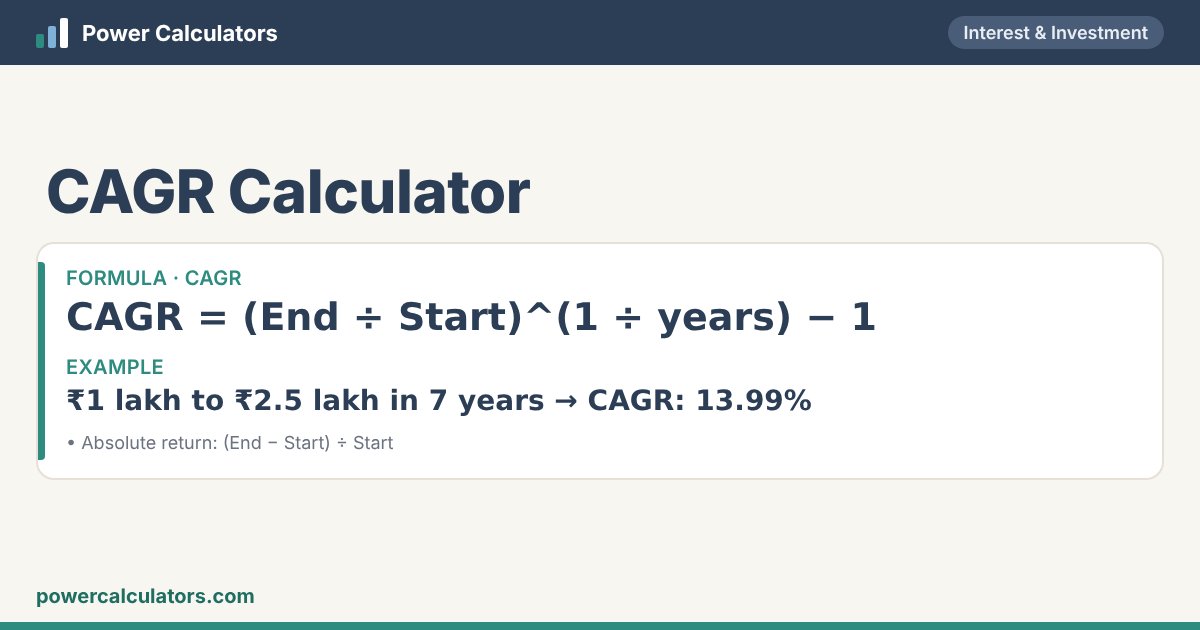
CAGR Calculator: CAGR — CAGR = (End ÷ Start)^(1 ÷ years) − 1. Example: ₹1 lakh to ₹2.5 lakh in 7 years → CAGR: 13.99%
How the CAGR Calculator works: CAGR — CAGR = (End ÷ Start)^(1 ÷ years) − 1

Rate this calculator

Was it useful? A quick star rating helps others — and you can leave a comment too.
Rate it: ★ ★ ★ ★ ★

📘 About the CAGR Calculator

CAGR is the steady yearly rate at which a value would have to grow to go from its starting figure to its ending figure. It smooths out the ups and downs, which makes it the standard way to compare mutual funds, stocks, property and company revenue over different periods.

CAGR is not the same as the average yearly return. A fund that gains 50% one year and loses 50% the next has an average return of 0% but a CAGR of −13.4%, because it ends below where it started. For SIPs or investments made at different times, use XIRR instead.

🧮 Formula

CAGR
CAGR = (End ÷ Start)^(1 ÷ years) − 1
Absolute return
(End − Start) ÷ Start

✏️ Worked examples

₹1 lakh to ₹2.5 lakh in 7 years

You enter
Starting value100000
Ending value250000
Number of years7 years
You get
CAGR13.99%
Absolute return150%
Growth2.5×
Years to double at this rate5.3 years

The investment grew at a CAGR of 13.99%.

Sales from ₹40 crore to ₹65 crore in 4 years

You enter
Starting value40
Ending value65
Number of years4 years
You get
CAGR12.91%
Absolute return62.5%
Growth1.625×
Years to double at this rate5.7 years

Company sales grew at 12.91% a year.

🧭 How to use this calculator

What you enter

  • Starting value
  • Ending value
  • Number of years (years)Use decimals for part years: 2.5 = two and a half years.

What you get

  • CAGR
  • Absolute return
  • Growth
  • Years to double at this rate

❓ Frequently asked questions

What is a good CAGR?

For Indian equity mutual funds, 12–15% over 10 years is good. Fixed deposits give 6–7.5%. Compare CAGR with inflation (about 5–6%) to see the real growth.

What is the difference between CAGR and XIRR?

CAGR suits a single investment with one start and one end value. XIRR handles several investments and withdrawals on different dates, such as a SIP.

Can CAGR be negative?

Yes, if the ending value is lower than the starting value.