💼 Lumpsum Calculator: One-Time Mutual Fund Investment Returns

Enter how much you invest once, the return you expect and for how long, to see the value year by year.

5.0 out of 5 (1 rating)

Enter details

Equity funds have averaged 10–14% over long periods; debt funds 6–8%.
Shows what the final amount is worth in today's rupees. Enter 0 to skip.

Log in or create a free account to save your inputs and results, so you don't have to enter them again next time.🔒 No spam, ever. We never sell or share your details, and you can delete your history or account at any time. Privacy policy

Fill in the details and click Calculate to see your results.

Formula at a glance

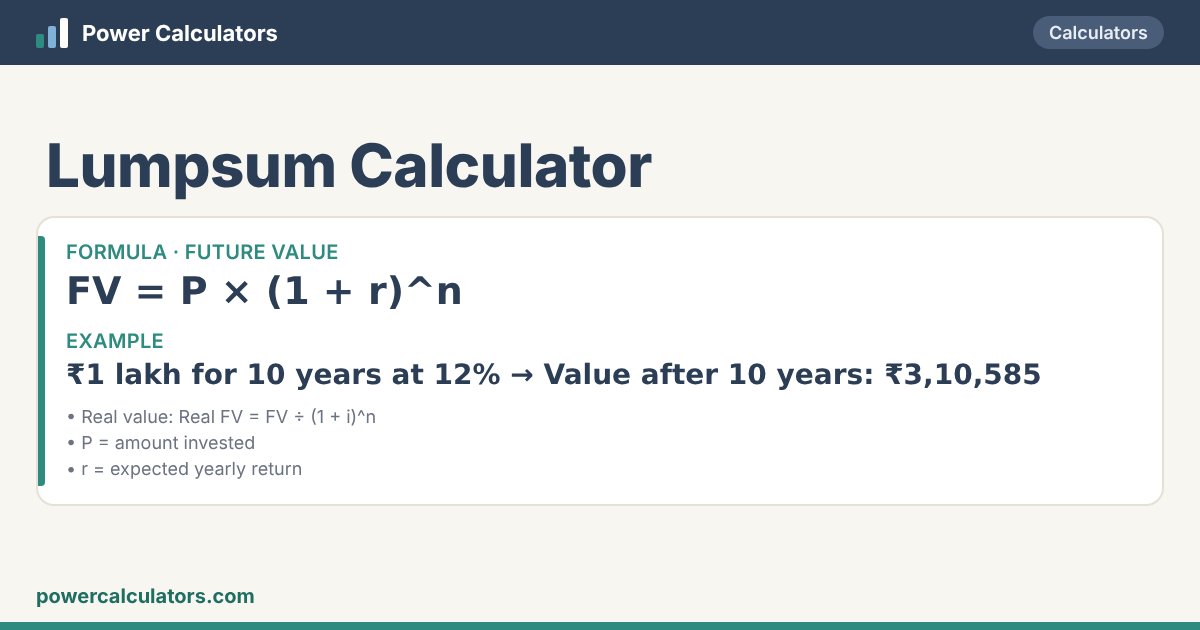
Lumpsum Calculator: Future value — FV = P × (1 + r)^n. Example: ₹1 lakh for 10 years at 12% → Value after 10 years: ₹3,10,585
How the Lumpsum Calculator works: Future value — FV = P × (1 + r)^n

Rate this calculator

Was it useful? A quick star rating helps others — and you can leave a comment too.
Rate it: ★ ★ ★ ★ ★

📘 About the Lumpsum Calculator

A lumpsum is a single investment made all at once, for example putting a bonus or the proceeds of a property sale into a mutual fund. Unlike a SIP, the whole amount is invested from day one, so it compounds for the full period. The longer you stay invested, the larger the share of the final value that comes from returns rather than your own money.

This calculator compounds the amount once a year at a steady rate. Real markets rise and fall, so a lumpsum in equity carries timing risk: investing just before a fall hurts more than with a SIP. Many investors put a lumpsum into a liquid fund and move it into equity through a systematic transfer plan (STP) over 6 to 12 months.

Adding an inflation rate shows the value in today's money. At 6% inflation, ₹3.1 lakh in ten years buys roughly what ₹1.73 lakh buys today.

🧮 Formula

Future value
FV = P × (1 + r)^n
Real value
Real FV = FV ÷ (1 + i)^n

Where

  • P = amount invested
  • r = expected yearly return
  • n = number of years
  • i = inflation rate

✏️ Worked examples

₹1 lakh for 10 years at 12%

You enter
Amount invested₹100,000
Expected return a year12%
Investment period10 years
Inflation (optional)6%
You get
Value after 10 years₹3,10,585
Amount invested₹1,00,000
Estimated returns₹2,10,585
Growth3.11× your money
In today's money (after 6% inflation)₹1,73,429

A ₹1 lakh lumpsum at 12% a year grows to ₹3,10,585.

₹5 lakh for 20 years at 11%

You enter
Amount invested₹500,000
Expected return a year11%
Investment period20 years
Inflation (optional)6%
You get
Value after 20 years₹40,31,156
Amount invested₹5,00,000
Estimated returns₹35,31,156
Growth8.06× your money
In today's money (after 6% inflation)₹12,56,933

Left for 20 years, ₹5 lakh grows to ₹40,31,156.

🧭 How to use this calculator

What you enter

  • Amount invested (₹)
  • Expected return a year (%)Equity funds have averaged 10–14% over long periods; debt funds 6–8%.
  • Investment period (years)
  • Inflation (optional) (%)Shows what the final amount is worth in today's rupees. Enter 0 to skip.

What you get

  • Value after 10 years
  • Amount invested
  • Estimated returns
  • Growth
  • In today's money (after 6% inflation)

❓ Frequently asked questions

What is a lumpsum investment?

A one-time investment of a large amount, as opposed to a SIP, where you invest a fixed sum every month.

Is lumpsum better than SIP?

Over long periods a lumpsum invested early often ends higher because all of it compounds from day one. A SIP spreads the timing risk. If markets look expensive, spread the lumpsum over 6–12 months using an STP.

How much will ₹1 lakh become in 10 years?

At 12% a year it becomes about ₹3.11 lakh; at 8% about ₹2.16 lakh; at 15% about ₹4.05 lakh.

How are lumpsum mutual fund returns taxed?

For equity funds held over 12 months, gains above ₹1.25 lakh a year are taxed at 12.5%; under 12 months, at 20%. Debt fund gains are added to your income and taxed at your slab rate.

What people are saying
★★★★★
Anonymous · 26 Nov 2026