🎲 Probability Calculator (Two Events: And, Or, Given)

Combine two probabilities with the addition, multiplication and conditional rules.

No ratings yet — be the first

Enter details

0.5, 50% or 1/2
probability A happens at least once

Log in or create a free account to save your inputs and results, so you don't have to enter them again next time.🔒 No spam, ever. We never sell or share your details, and you can delete your history or account at any time. Privacy policy

Fill in the details and click Calculate to see your results.

Formula at a glance

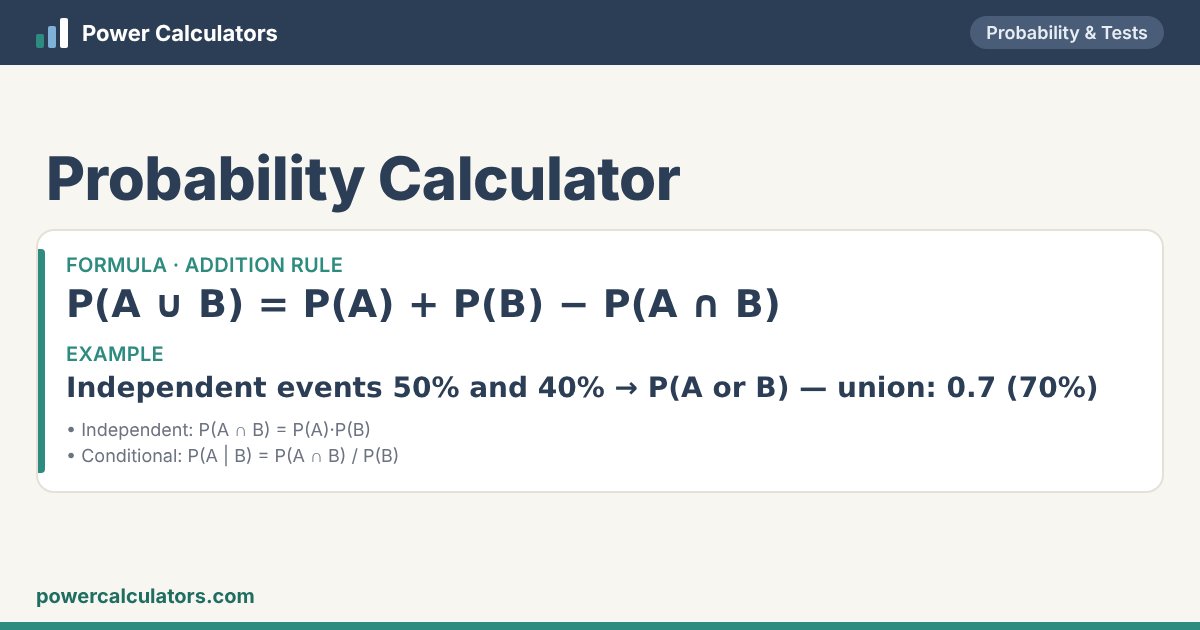
Probability Calculator: Addition rule — P(A ∪ B) = P(A) + P(B) − P(A ∩ B). Example: Independent events 50% and 40% → P(A or B) — union: 0.7 (70%)
How the Probability Calculator works: Addition rule — P(A ∪ B) = P(A) + P(B) − P(A ∩ B)

Rate this calculator

Was it useful? A quick star rating helps others — and you can leave a comment too.
Rate it: ★ ★ ★ ★ ★

📘 About the Probability Calculator

Probability measures how likely an event is, from 0 (impossible) to 1 (certain). With two events you often need the chance that both happen (intersection), that at least one happens (union), that one happens given the other, or that neither happens.

Enter P(A) and P(B) and say whether the events are independent, mutually exclusive or have a known overlap. The calculator applies the addition, multiplication and conditional probability rules and shows every combination, plus the chance of A happening at least once in repeated tries.

🧮 Formula

Addition rule
P(A ∪ B) = P(A) + P(B) − P(A ∩ B)
Independent
P(A ∩ B) = P(A)·P(B)
Conditional
P(A | B) = P(A ∩ B) / P(B)
At least once in n tries
1 − (1 − p)ⁿ

✏️ Worked examples

Independent events 50% and 40%

You enter
P(A)0.5
P(B)0.4
A and B areIndependent
You get
P(A or B) — union0.7 (70%)
P(A and B) — intersection0.2 (20%)
P(not A) · P(not B)0.5 · 0.6
P(neither A nor B)0.3 (30%)
P(exactly one of A, B)0.5 (50%)
P(A | B) — A given B0.5 (50%)
P(B | A) — B given A0.4 (40%)
Independent?Yes — P(A and B) = P(A)·P(B)

0.7 (70%).

Rolling a six at least once in 4 throws

You enter
P(A)1/6
P(B)0.5
A and B areIndependent
Repeat A this many times (optional)4
You get
P(A or B) — union0.583333 (58.3333%)
P(A and B) — intersection0.0833333 (8.33333%)
P(not A) · P(not B)0.833333 · 0.5
P(neither A nor B)0.416667 (41.6667%)
P(exactly one of A, B)0.5 (50%)
P(A | B) — A given B0.166667 (16.6667%)
P(B | A) — B given A0.5 (50%)
Independent?Yes — P(A and B) = P(A)·P(B)
A at least once in 4 independent tries0.517747 (51.7747%)

0.517747 (51.7747%).

🧭 How to use this calculator

What you enter

  • P(A)0.5, 50% or 1/2
  • P(B)
  • A and B are
  • P(A and B) (if known)
  • Repeat A this many times (optional)probability A happens at least once

What you get

  • P(A or B) — union
  • P(A and B) — intersection
  • P(not A) · P(not B)
  • P(neither A nor B)
  • P(exactly one of A, B)
  • P(A | B) — A given B
  • P(B | A) — B given A
  • Independent?

❓ Frequently asked questions

What is the difference between independent and mutually exclusive?

Independent events do not affect each other (two coin tosses). Mutually exclusive events cannot happen together (rolling a 2 and a 5 on one die).

How do I find the probability of A or B?

Add their probabilities and subtract the overlap: P(A) + P(B) − P(A and B).

What is the chance of at least one six in four rolls?

1 − (5/6)⁴ ≈ 51.8%.