About the Remainder Calculator
A remainder is what is left after division when the division is not exact.
The calculator also shows the integer quotient used to construct the remainder.
Calculate the quotient and remainder when one number is divided by another.
Log in or create a free account to save your inputs and results, so you don't have to enter them again next time.🔒 No spam, ever. We never sell or share your details, and you can delete your history or account at any time. Privacy policy
Fill in the details and click Calculate to see your results.
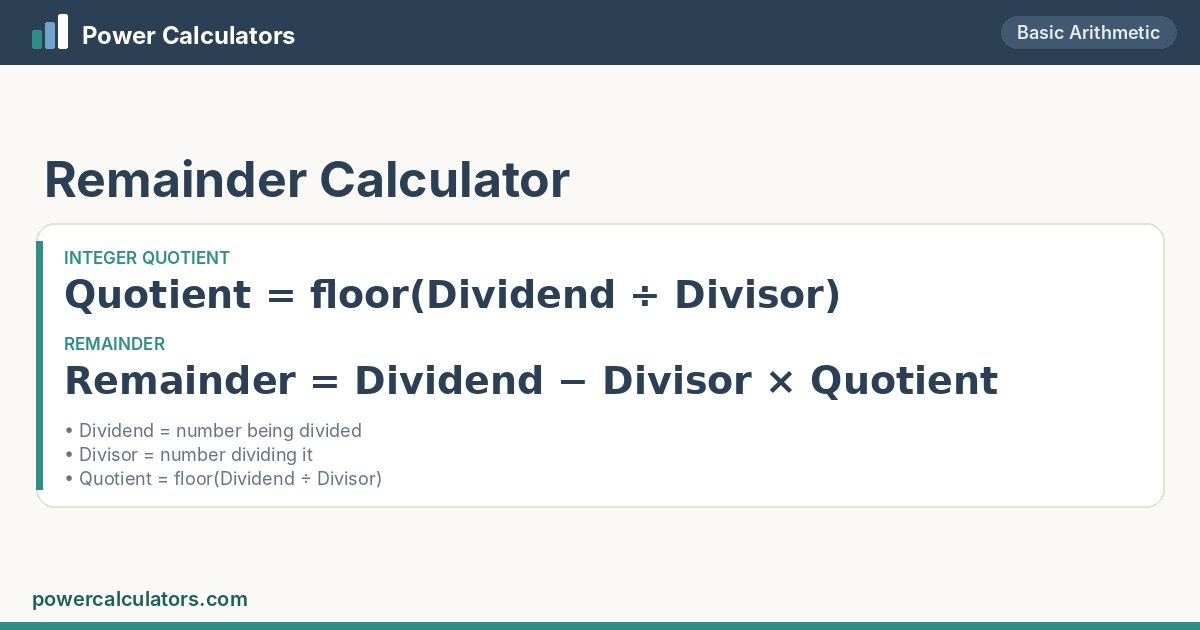
A remainder is what is left after division when the division is not exact.
The calculator also shows the integer quotient used to construct the remainder.
| Dividend | 17 |
| Divisor | 5 |
| Answer | 17 ÷ 5 = 3 remainder 2 |
| Quotient | 3 |
| Remainder | 2 |
| As a mixed number | 3 2/5 |
| As a decimal | 3.4 |
| Check | 5 × 3 + 2 = 17 |
17 ÷ 5 = 3 remainder 2.
| Dividend | 100 |
| Divisor | 7 |
| Answer | 100 ÷ 7 = 14 remainder 2 |
| Quotient | 14 |
| Remainder | 2 |
| As a mixed number | 14 2/7 |
| As a decimal | 14.28571429 |
| Check | 7 × 14 + 2 = 100 |
100 ÷ 7 = 14 remainder 2.
| Dividend | 1234 |
| Divisor | 25 |
| Answer | 1234 ÷ 25 = 49 remainder 9 |
| Quotient | 49 |
| Remainder | 9 |
| As a mixed number | 49 9/25 |
| As a decimal | 49.36 |
| Check | 25 × 49 + 9 = 1234 |
1234 ÷ 25 = 49 remainder 9.
It is the amount left after dividing a number by another number.
The remainder is 0 because 20 divides evenly by 5.
Divide, take the whole-number part of the answer (quotient), multiply it by the divisor and subtract from the dividend. 100 ÷ 7: 7 × 14 = 98, remainder 2.