💧 Water Quality Index Calculator (WQI, BIS 10500)

One number from a water test report — and what it hides.

No ratings yet — be the first

Enter details

Leave any parameter at 0 if you did not measure it.

Log in or create a free account to save your inputs and results, so you don't have to enter them again next time.🔒 No spam, ever. We never sell or share your details, and you can delete your history or account at any time. Privacy policy

Fill in the details and click Calculate to see your results.

Formula at a glance

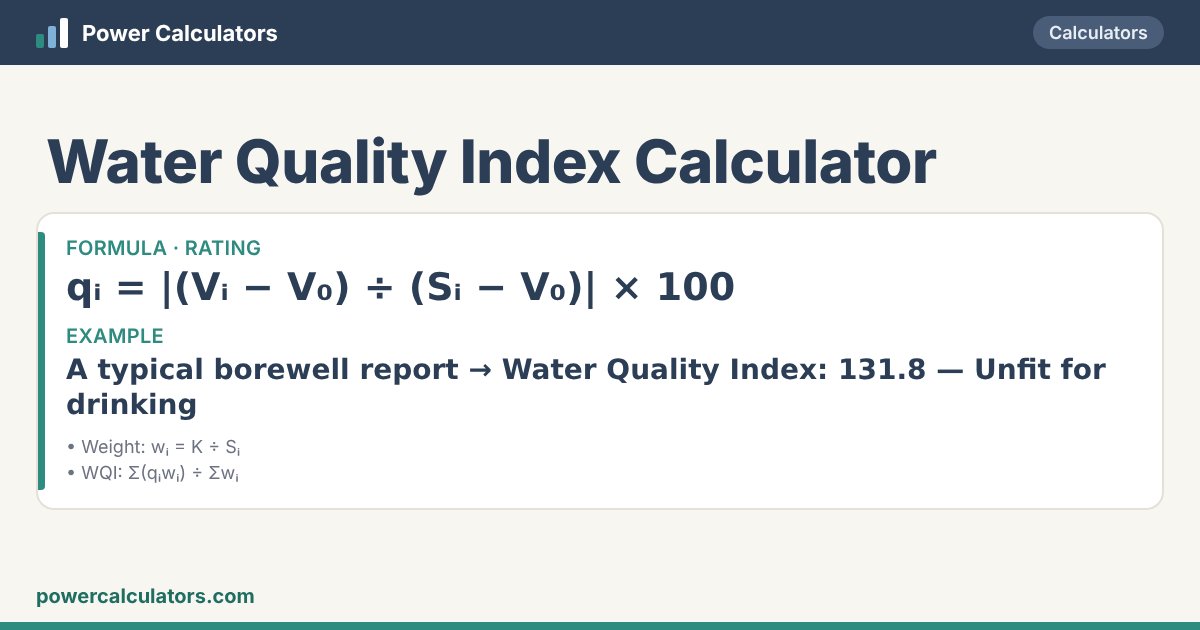
Water Quality Index Calculator: Rating — qᵢ = |(Vᵢ − V₀) ÷ (Sᵢ − V₀)| × 100. Example: A typical borewell report → Water Quality Index: 131.8 — Unfit for drinking
How the Water Quality Index Calculator works: Rating — qᵢ = |(Vᵢ − V₀) ÷ (Sᵢ − V₀)| × 100

Rate this calculator

Was it useful? A quick star rating helps others — and you can leave a comment too.
Rate it: ★ ★ ★ ★ ★

📘 About the Water Quality Index Calculator

The weighted arithmetic water quality index turns a test report into a single figure. Each parameter gets a quality rating qᵢ = |(measured − ideal) ÷ (standard − ideal)| × 100, and a weight wᵢ = K ÷ standard, so that parameters with tight limits count for more. WQI is the weighted mean of the ratings.

The standards used here are the BIS 10500:2012 acceptable limits for drinking water — pH 8.5, TDS 500 mg/L, turbidity 1 NTU, hardness 200, chloride 250, nitrate 45, fluoride 1.0, iron 0.3, sulphate 200 — with dissolved oxygen handled the other way round, where 14.6 mg/L is ideal and 5 the standard. Fluoride, iron and turbidity therefore carry much more weight than TDS or hardness.

The classes are 0-25 excellent, 26-50 good, 51-75 poor, 76-100 very poor and above 100 unfit for drinking. What the index cannot see matters as much as what it reports: no bacteria, no coliform, no pesticides, no arsenic and no heavy metals. Water with an excellent WQI can still make you ill, and a bacteriological test is a separate job.

🧮 Formula

Rating
qᵢ = |(Vᵢ − V₀) ÷ (Sᵢ − V₀)| × 100
Weight
wᵢ = K ÷ Sᵢ
WQI
Σ(qᵢwᵢ) ÷ Σwᵢ

✏️ Worked examples

A typical borewell report

You enter
pH7.6
Total dissolved solids (mg/L)620
Turbidity (NTU)2
Total hardness as CaCO₃ (mg/L)240
Chloride (mg/L)180
Nitrate (mg/L)32
Fluoride (mg/L)0.8
Iron (mg/L)0.4
Sulphate (mg/L)0
Dissolved oxygen (mg/L)6.2
You get
Water Quality Index131.8 — Unfit for drinking
Parameters used9 of 10
Over the BIS acceptable limitTotal dissolved solids, Turbidity, Total hardness as CaCO₃, Iron
Where the classes fall0-25 excellent, 26-50 good, 51-75 poor, 76-100 very poor, above 100 unfit for drinking
Fit to drink?not on these parameters alone

WQI 131.8 — Unfit for drinking. Over the BIS limit: Total dissolved solids, Turbidity, Total hardness as CaCO₃, Iron.

Treated municipal supply

You enter
pH7.2
Total dissolved solids (mg/L)210
Turbidity (NTU)0.5
Total hardness as CaCO₃ (mg/L)120
Chloride (mg/L)60
Nitrate (mg/L)8
Fluoride (mg/L)0.5
Iron (mg/L)0.1
Sulphate (mg/L)0
Dissolved oxygen (mg/L)7.5
You get
Water Quality Index40.2 — Good
Parameters used9 of 10
Over the BIS acceptable limitnone — every parameter is inside BIS 10500 acceptable limits
Where the classes fall0-25 excellent, 26-50 good, 51-75 poor, 76-100 very poor, above 100 unfit for drinking
Fit to drink?on these parameters, yes — but a WQI says nothing about bacteria

WQI 40.2 — Good.

High-fluoride groundwater

You enter
pH8.1
Total dissolved solids (mg/L)980
Turbidity (NTU)1.5
Total hardness as CaCO₃ (mg/L)320
Chloride (mg/L)240
Nitrate (mg/L)48
Fluoride (mg/L)2.4
Iron (mg/L)0.6
Sulphate (mg/L)0
Dissolved oxygen (mg/L)5.5
You get
Water Quality Index191.4 — Unfit for drinking
Parameters used9 of 10
Over the BIS acceptable limitTotal dissolved solids, Turbidity, Total hardness as CaCO₃, Nitrate, Fluoride, Iron
Where the classes fall0-25 excellent, 26-50 good, 51-75 poor, 76-100 very poor, above 100 unfit for drinking
Fit to drink?not on these parameters alone

WQI 191.4 — Unfit for drinking. Over the limit: Total dissolved solids, Turbidity, Total hardness as CaCO₃, Nitrate, Fluoride, Iron.

🧭 How to use this calculator

What you enter

  • pH
  • Total dissolved solids (mg/L)
  • Turbidity (NTU)
  • Total hardness as CaCO₃ (mg/L)
  • Chloride (mg/L)
  • Nitrate (mg/L)
  • Fluoride (mg/L)
  • Iron (mg/L)
  • Sulphate (mg/L)
  • Dissolved oxygen (mg/L)Leave any parameter at 0 if you did not measure it.

What you get

  • Water Quality Index
  • Parameters used
  • Over the BIS acceptable limit
  • Where the classes fall
  • Fit to drink?

💡 BIS 10500:2012 acceptable limits used here

  • pH 6.5-8.5 · total dissolved solids 500 mg/L · turbidity 1 NTU.
  • Total hardness 200 mg/L as CaCO₃ · chloride 250 mg/L · sulphate 200 mg/L.
  • Nitrate 45 mg/L · fluoride 1.0 mg/L · iron 0.3 mg/L.
  • Dissolved oxygen is treated in reverse: 14.6 mg/L ideal, 5 mg/L the standard.
  • Where no alternative source exists, BIS also sets higher permissible limits — for example hardness 600 and TDS 2,000 mg/L.

❓ Frequently asked questions

How is the water quality index calculated?

Each parameter is rated against its standard, weighted by the inverse of that standard, and averaged: WQI = Σ(qᵢwᵢ) ÷ Σwᵢ. Below 25 is excellent and above 100 is unfit for drinking.

What WQI is safe to drink?

On this scale, 50 or below is usually read as good. But the index covers chemistry only — water that passes it can still be bacteriologically unsafe.

What are the BIS 10500 limits?

The acceptable limits for drinking water include pH 6.5-8.5, TDS 500 mg/L, turbidity 1 NTU, hardness 200, chloride 250, nitrate 45, fluoride 1.0 and iron 0.3 mg/L.

Why does fluoride affect the index so much?

Because the weight is the inverse of the standard, and fluoride's limit of 1.0 mg/L is one of the tightest. Small exceedances in tightly limited parameters move the index a long way.

Does WQI include bacteria?

No. Total coliform and E. coli are tested separately, and their result is pass or fail rather than a contribution to an index.

Can I use WQI for a river or lake?

The same arithmetic is used, but with standards for that use — irrigation or aquatic life rather than drinking. The BIS limits here are for drinking water.