∂y Implicit Differentiation Calculator (dy/dx)

Differentiate both sides, collect dy/dx and solve — for curves you cannot write as y = f(x).

No ratings yet — be the first

Enter details

Log in or create a free account to save your inputs and results, so you don't have to enter them again next time.🔒 No spam, ever. We never sell or share your details, and you can delete your history or account at any time. Privacy policy

Fill in the details and click Calculate to see your results.

Formula at a glance

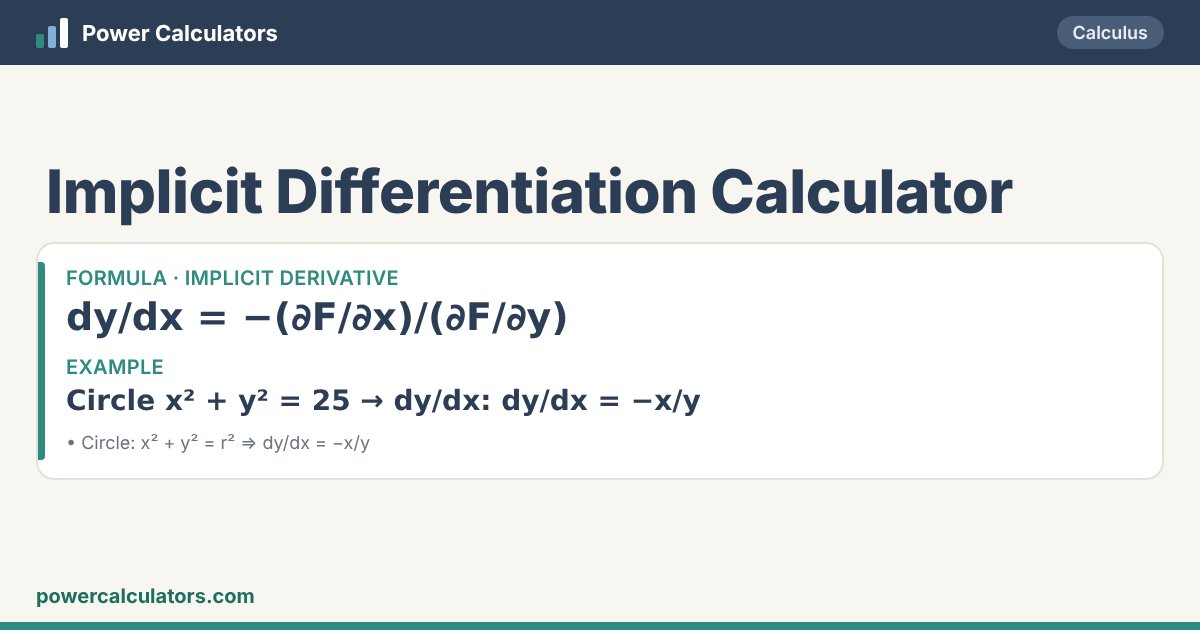
Implicit Differentiation Calculator: Implicit derivative — dy/dx = −(∂F/∂x)/(∂F/∂y). Example: Circle x² + y² = 25 → dy/dx: dy/dx = −x/y
How the Implicit Differentiation Calculator works: Implicit derivative — dy/dx = −(∂F/∂x)/(∂F/∂y)

Rate this calculator

Was it useful? A quick star rating helps others — and you can leave a comment too.
Rate it: ★ ★ ★ ★ ★

📘 About the Implicit Differentiation Calculator

Some curves, like circles x² + y² = r² or the folium x³ + y³ = 6xy, cannot easily be written as y = f(x). Implicit differentiation finds their slope anyway: differentiate both sides with respect to x, remembering that y depends on x, so every y-term picks up a factor dy/dx by the chain rule.

The calculator moves everything to one side, F(x, y) = 0, and uses dy/dx = −F_x/F_y, where F_x and F_y are partial derivatives. It simplifies the answer, gives the slope and tangent line at a point on the curve, and the second derivative d²y/dx².

🧮 Formula

Implicit derivative
dy/dx = −(∂F/∂x)/(∂F/∂y)
Circle
x² + y² = r² ⇒ dy/dx = −x/y

✏️ Worked examples

Circle x² + y² = 25

You enter
Equation in x and yx^2 + y^2 = 25
Independent variablex
Dependent variabley
You get
dy/dxdy/dx = −x/y
Second derivatived²y/dx² = −x²/y³ − 1/y

dy/dx = −x/y.

Folium of Descartes at (3, 3)

You enter
Equation in x and yx^3 + y^3 = 6xy
Point (optional)x=3, y=3
Independent variablex
Dependent variabley
You get
dy/dxdy/dx = (2y − x²)/(y² − 2x)
Slope at (3, 3)−1
Tangent liney = 6 − x

dy/dx = (2y − x²)/(y² − 2x); slope −1.

🧭 How to use this calculator

What you enter

  • Equation in x and y
  • Point (optional)
  • Independent variable
  • Dependent variable

What you get

  • dy/dx
  • Second derivative

❓ Frequently asked questions

When do I use implicit differentiation?

When y is not isolated — circles, ellipses, curves like xy + sin y = x² — or when it is easier than solving for y.

Why does dy/dx appear next to y terms?

Because y is a function of x: by the chain rule d/dx(y²) = 2y·dy/dx.

What is dy/dx for x² + y² = 25?

−x/y. At (3, 4) the slope is −3/4, so the tangent is y = −3x/4 + 25/4.