📐 Definite Integral Calculator: Area Under a Curve

Find ∫ₐᵇ f(x) dx — exact where possible — with the area under the curve and a graph.

No ratings yet — be the first

Enter details

Use ^ for powers, * or nothing for ×: 3x^2 + 2sin(x), e^(2x), sqrt(x+1), ln(x).
One letter. Other letters are treated as constants.

Log in or create a free account to save your inputs and results, so you don't have to enter them again next time.🔒 No spam, ever. We never sell or share your details, and you can delete your history or account at any time. Privacy policy

Fill in the details and click Calculate to see your results.

Formula at a glance

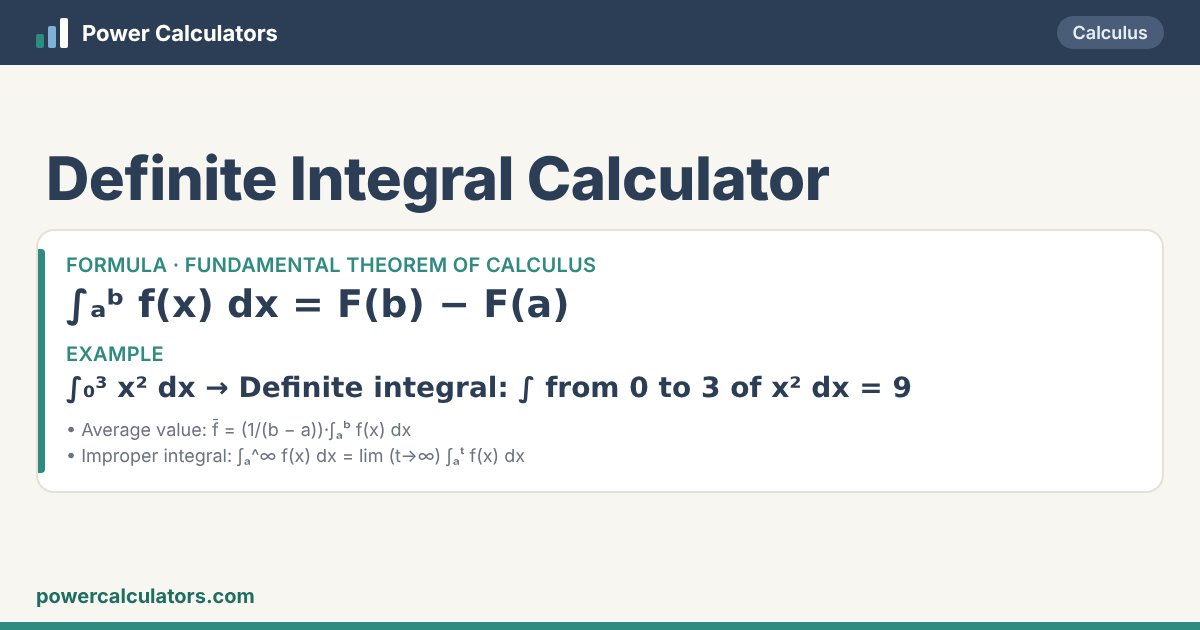
Definite Integral Calculator: Fundamental Theorem of Calculus — ∫ₐᵇ f(x) dx = F(b) − F(a). Example: ∫₀³ x² dx → Definite integral: ∫ from 0 to 3 of x² dx = 9
How the Definite Integral Calculator works: Fundamental Theorem of Calculus — ∫ₐᵇ f(x) dx = F(b) − F(a)

Rate this calculator

Was it useful? A quick star rating helps others — and you can leave a comment too.
Rate it: ★ ★ ★ ★ ★

📘 About the Definite Integral Calculator

A definite integral adds up f(x) between two limits: the signed area between the graph and the x-axis (area below the axis counts as negative). It turns rates into totals — distance from speed, work from force, probability from a density.

The calculator first finds an antiderivative and applies F(b) − F(a) for an exact answer such as 9, 2 or π/4, then checks it numerically with adaptive Simpson’s rule. It also handles integrals with no simple antiderivative and infinite limits (improper integrals), and shows the total unsigned area and the average value of the function.

🧮 Formula

Fundamental Theorem of Calculus
∫ₐᵇ f(x) dx = F(b) − F(a)
Average value
f̄ = (1/(b − a))·∫ₐᵇ f(x) dx
Improper integral
∫ₐ^∞ f(x) dx = lim (t→∞) ∫ₐᵗ f(x) dx

✏️ Worked examples

∫₀³ x² dx

You enter
Integrand f(x)x^2
Variablex
Lower limit a0
Upper limit b3
You get
Definite integral∫ from 0 to 3 of x² dx = 9
Decimal value9
Average value of f on the interval3

∫ from 0 to 3 of x² dx = 9.

∫₀^π sin x dx

You enter
Integrand f(x)sin(x)
Variablex
Lower limit a0
Upper limit bpi
You get
Definite integral∫ from 0 to π of sin(x) dx = 2
Decimal value2
Average value of f on the interval0.6366197724

∫ from 0 to π of sin(x) dx = 2.

🧭 How to use this calculator

What you enter

  • Integrand f(x)Use ^ for powers, * or nothing for ×: 3x^2 + 2sin(x), e^(2x), sqrt(x+1), ln(x).
  • VariableOne letter. Other letters are treated as constants.
  • Lower limit a
  • Upper limit b

What you get

  • Definite integral
  • Decimal value
  • Average value of f on the interval

❓ Frequently asked questions

What is the difference between a definite and an indefinite integral?

An indefinite integral is a function plus C (the antiderivative). A definite integral has limits and gives a number — the net area between them.

Can a definite integral be negative?

Yes. Area below the x-axis counts as negative. The calculator also shows the total area with every part counted as positive.

How do I type infinity or π as a limit?

Type inf or -inf for ±∞, pi for π (pi/2, 2pi) and e for 2.718…

What is ∫ from −∞ to ∞ of e^(−x²)?

√π ≈ 1.7725 — the Gaussian integral, the basis of the normal distribution.