→ Limit Calculator with Steps (L’Hôpital’s Rule)

Find lim f(x) — with the method used, both one-sided limits and a table that shows the values closing in.

No ratings yet — be the first

Enter details

Use ^ for powers, * or nothing for ×: 3x^2 + 2sin(x), e^(2x), sqrt(x+1), ln(x).
One letter. Other letters are treated as constants.

Log in or create a free account to save your inputs and results, so you don't have to enter them again next time.🔒 No spam, ever. We never sell or share your details, and you can delete your history or account at any time. Privacy policy

Fill in the details and click Calculate to see your results.

Formula at a glance

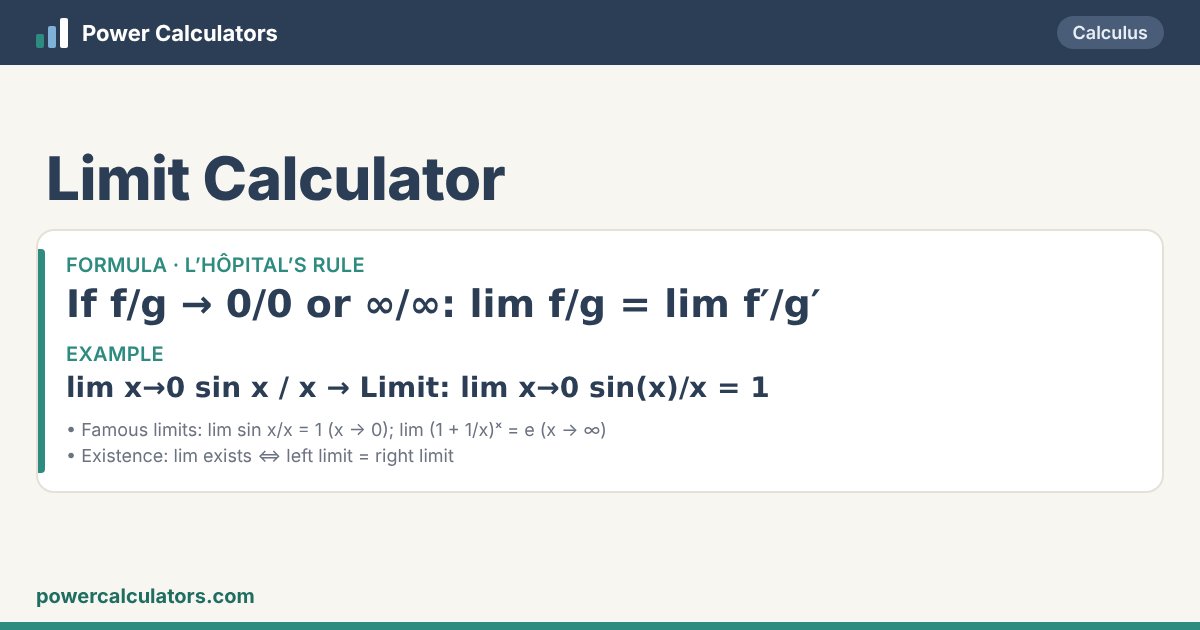
Limit Calculator: L’Hôpital’s rule — If f/g → 0/0 or ∞/∞: lim f/g = lim f′/g′. Example: lim x→0 sin x / x → Limit: lim x→0 sin(x)/x = 1
How the Limit Calculator works: L’Hôpital’s rule — If f/g → 0/0 or ∞/∞: lim f/g = lim f′/g′

Rate this calculator

Was it useful? A quick star rating helps others — and you can leave a comment too.
Rate it: ★ ★ ★ ★ ★

📘 About the Limit Calculator with Steps

A limit is the value a function approaches as x gets closer and closer to a point, even if the function is not defined there. Limits define continuity, derivatives and integrals, and describe behaviour at infinity (horizontal asymptotes).

The calculator tries direct substitution first. For 0/0 or ∞/∞ forms it applies L’Hôpital’s rule — differentiating the top and bottom — and shows each step. It also approaches the point numerically from both sides, so you can see when the left and right limits differ and the limit does not exist.

🧮 Formula

L’Hôpital’s rule
If f/g → 0/0 or ∞/∞: lim f/g = lim f′/g′
Famous limits
lim sin x/x = 1 (x → 0); lim (1 + 1/x)ˣ = e (x → ∞)
Existence
lim exists ⇔ left limit = right limit

✏️ Worked examples

lim x→0 sin x / x

You enter
Function f(x)sin(x)/x
Variablex
x approaches0
DirectionBoth sides (two-sided limit)
You get
Limitlim x→0 sin(x)/x = 1
Left-hand limit (x→0⁻)1
Right-hand limit (x→0⁺)1

lim x→0 sin(x)/x = 1.

lim x→∞ (1 + 1/x)ˣ

You enter
Function f(x)(1+1/x)^x
Variablex
x approachesinf
DirectionBoth sides (two-sided limit)
You get
Limitlim x→∞ (1/x + 1)^x = e ≈ 2.7182818

lim x→∞ (1/x + 1)^x = e ≈ 2.7182818.

🧭 How to use this calculator

What you enter

  • Function f(x)Use ^ for powers, * or nothing for ×: 3x^2 + 2sin(x), e^(2x), sqrt(x+1), ln(x).
  • VariableOne letter. Other letters are treated as constants.
  • x approaches
  • Direction

What you get

  • Limit
  • Left-hand limit (x→0⁻)
  • Right-hand limit (x→0⁺)

❓ Frequently asked questions

What does it mean when a limit does not exist?

The function does not settle on one value — the left and right limits differ (like |x|/x at 0), it grows without bound, or it oscillates (like sin(1/x)).

When can I use L’Hôpital’s rule?

Only for the indeterminate forms 0/0 and ∞/∞. Differentiate the numerator and denominator separately (not the quotient rule) and take the limit again.

How do I find a limit at infinity?

Divide by the highest power of x, or compare the growth of the top and bottom. Type inf for x → ∞.

What is lim (x→0) (1 − cos x)/x²?

1/2. Two applications of L’Hôpital’s rule give cos x/2 → 1/2.