Σ Summation Calculator (Sigma Notation Σ)

Add up Σ f(n) for n from a to b — and get the formula, like Σk = n(n + 1)/2.

No ratings yet — be the first

Enter details

One letter. Other letters are treated as constants.

Log in or create a free account to save your inputs and results, so you don't have to enter them again next time.🔒 No spam, ever. We never sell or share your details, and you can delete your history or account at any time. Privacy policy

Fill in the details and click Calculate to see your results.

Formula at a glance

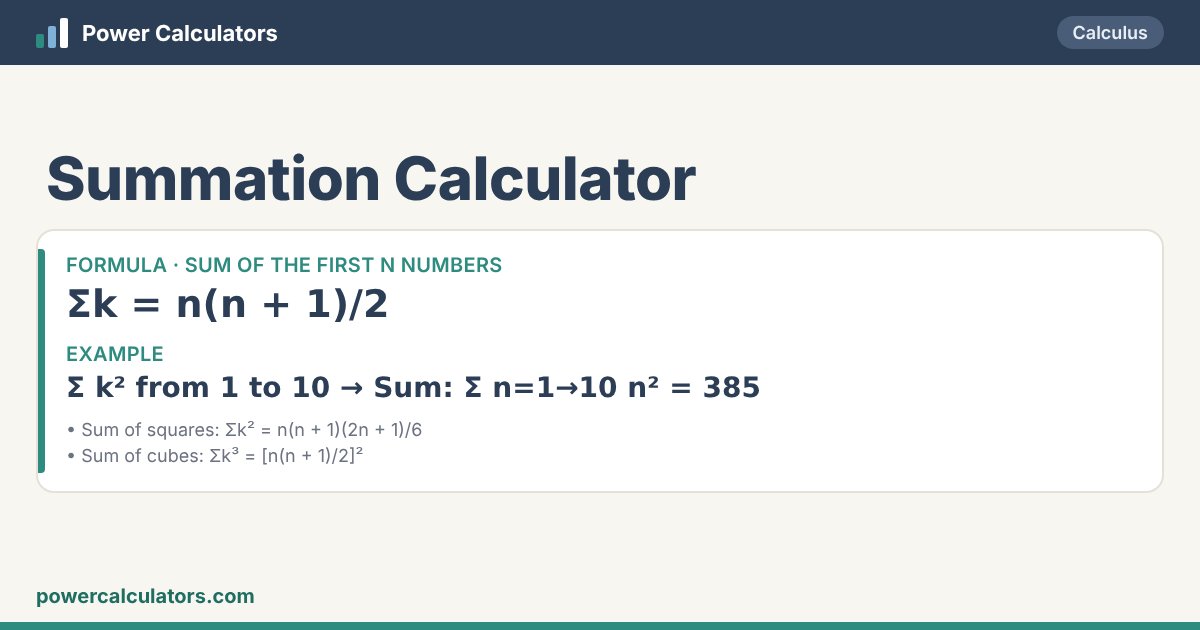
Summation Calculator: Sum of the first n numbers — Σk = n(n + 1)/2. Example: Σ k² from 1 to 10 → Sum: Σ n=1→10 n² = 385
How the Summation Calculator works: Sum of the first n numbers — Σk = n(n + 1)/2

Rate this calculator

Was it useful? A quick star rating helps others — and you can leave a comment too.
Rate it: ★ ★ ★ ★ ★

📘 About the Summation Calculator

Sigma notation Σ is shorthand for adding a pattern of terms: Σ from k = 1 to 10 of k² means 1² + 2² + … + 10² = 385. Sums appear in sequences and series, statistics (means and variances), finance (repeated deposits) and computer science (counting loop steps).

Type the expression, the index letter and the limits. The calculator adds the terms exactly (fractions stay fractions), lists the first terms, draws the running total and — for polynomial expressions — finds the closed formula for the sum up to n, like n(n + 1)(2n + 1)/6 for Σk².

🧮 Formula

Sum of the first n numbers
Σk = n(n + 1)/2
Sum of squares
Σk² = n(n + 1)(2n + 1)/6
Sum of cubes
Σk³ = [n(n + 1)/2]²

✏️ Worked examples

Σ k² from 1 to 10

You enter
Expressionn^2
Variablen
From (lower limit)1
To (upper limit)10
You get
SumΣ n=1→10 n² = 385
Number of terms10
Expanded1 + 4 + 9 + 16 + 25 + 36 + …
Formula for the first terms up to nΣ = n(n + 1)(2n + 1)/6

Σ n=1→10 n² = 385.

Telescoping Σ 1/(n(n + 1))

You enter
Expression1/(n(n+1))
Variablen
From (lower limit)1
To (upper limit)20
You get
SumΣ n=1→20 1/(n(n + 1)) = 20/21 ≈ 0.9523809524
Number of terms20
Expanded1/2 + 1/6 + 1/12 + 1/20 + 1/30 + 1/42 + …

Σ n=1→20 1/(n(n + 1)) = 20/21 ≈ 0.9523809524.

🧭 How to use this calculator

What you enter

  • Expression
  • VariableOne letter. Other letters are treated as constants.
  • From (lower limit)
  • To (upper limit)

What you get

  • Sum
  • Number of terms
  • Expanded
  • Formula for the first terms up to n

❓ Frequently asked questions

What is the sum of 1 to 100?

5,050 = 100 × 101 ÷ 2 — the trick Gauss is said to have used as a schoolboy.

How do I read sigma notation?

Σ from i = a to b of f(i) means substitute every whole number i from a to b into f and add the results.

What is a telescoping sum?

One where most terms cancel, like Σ 1/(n(n + 1)) = Σ (1/n − 1/(n + 1)) = 1 − 1/(N + 1).