Σ Infinite Series Calculator: Sum & Convergence Tests

Does Σaₙ converge, and to what? See the tests, the sum and how the partial sums settle.

No ratings yet — be the first

Enter details

One letter. Other letters are treated as constants.

Log in or create a free account to save your inputs and results, so you don't have to enter them again next time.🔒 No spam, ever. We never sell or share your details, and you can delete your history or account at any time. Privacy policy

Fill in the details and click Calculate to see your results.

Formula at a glance

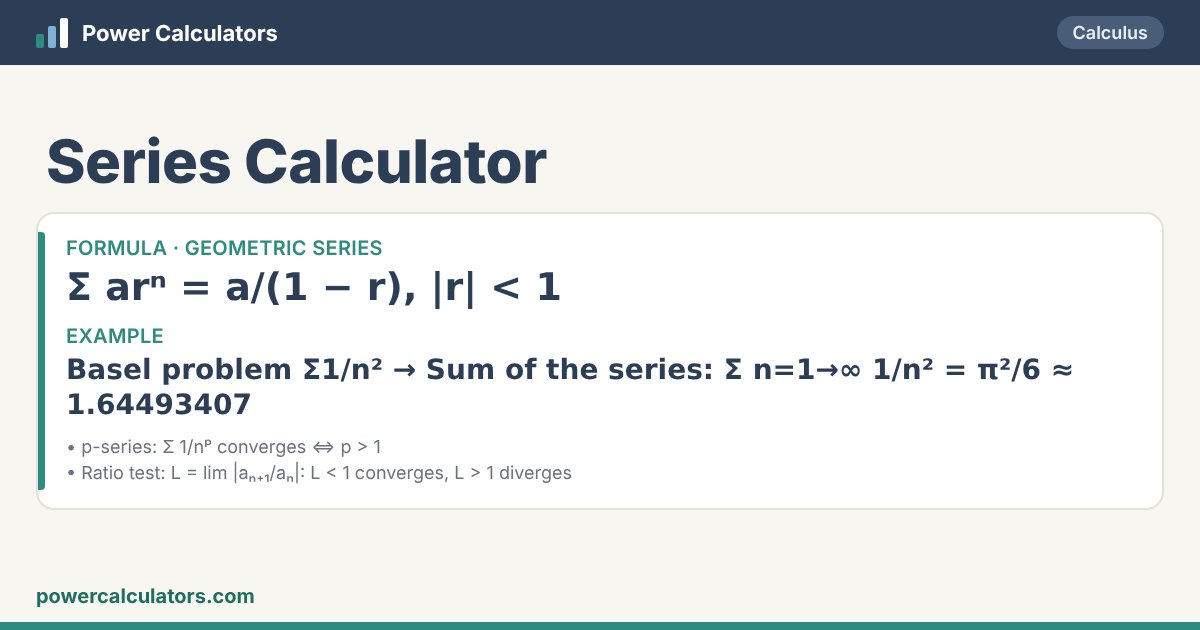
Series Calculator: Geometric series — Σ arⁿ = a/(1 − r), |r| < 1. Example: Basel problem Σ1/n² → Sum of the series: Σ n=1→∞ 1/n² = π²/6 ≈ 1.64493407
How the Series Calculator works: Geometric series — Σ arⁿ = a/(1 − r), |r| < 1

Rate this calculator

Was it useful? A quick star rating helps others — and you can leave a comment too.
Rate it: ★ ★ ★ ★ ★

📘 About the Infinite Series Calculator

An infinite series adds infinitely many terms. It converges if its partial sums approach a finite number — Σ1/2ⁿ = 1 and Σ1/n² = π²/6 — and diverges otherwise, like the harmonic series Σ1/n, which grows without limit even though its terms shrink to 0.

The calculator applies the standard tests in order: the n-th term test, the ratio test, the alternating series test and comparison with a p-series. If the series converges it estimates the sum from 200,000 terms with a tail correction and recognises famous exact values such as π²/6 and ln 2.

🧮 Formula

Geometric series
Σ arⁿ = a/(1 − r), |r| < 1
p-series
Σ 1/nᵖ converges ⇔ p > 1
Ratio test
L = lim |aₙ₊₁/aₙ|: L < 1 converges, L > 1 diverges

✏️ Worked examples

Basel problem Σ1/n²

You enter
General term aₙ1/n^2
Variablen
Start at n =1
You get
Sum of the seriesΣ n=1→∞ 1/n² = π²/6 ≈ 1.64493407
Converges?Yes — comparison with the p-series Σ1/nᵖ, p ≈ 2
First terms1, 0.25, 0.111111, 0.0625, 0.04, 0.0277778, 0.0204082, 0.015625, 0.0123457, 0.01, …
Partial sumsS1 = 1 · S2 = 1.25 · S3 = 1.361111111 · S4 = 1.423611111 · S5 = 1.463611111

Σ n=1→∞ 1/n² = π²/6 ≈ 1.64493407.

Alternating harmonic series

You enter
General term aₙ(-1)^(n+1)/n
Variablen
Start at n =1
You get
Sum of the seriesΣ n=1→∞ (−1)^(n + 1)/n = ln 2 ≈ 0.693147181
Converges?Yes — alternating series test: the terms alternate in sign and shrink to 0
First terms1, −0.5, 0.333333, −0.25, 0.2, −0.166667, 0.142857, −0.125, 0.111111, −0.1, …
Partial sumsS1 = 1 · S2 = 0.5 · S3 = 0.8333333333 · S4 = 0.5833333333 · S5 = 0.7833333333

Σ n=1→∞ (−1)^(n + 1)/n = ln 2 ≈ 0.693147181.

🧭 How to use this calculator

What you enter

  • General term aₙ
  • VariableOne letter. Other letters are treated as constants.
  • Start at n =

What you get

  • Sum of the series
  • Converges?
  • First terms
  • Partial sums

❓ Frequently asked questions

Does the harmonic series converge?

No. Σ1/n diverges — its partial sums grow like ln n — even though the terms go to 0.

What is the sum of 1 + 1/4 + 1/9 + 1/16 + …?

π²/6 ≈ 1.644934, first proved by Euler (the Basel problem).

What is the difference between absolute and conditional convergence?

A series converges absolutely if Σ|aₙ| converges. Σ(−1)ⁿ⁺¹/n converges (to ln 2) but only conditionally, because Σ1/n diverges.