s² Variance Calculator (Sample & Population)

Variance with every step: the mean, each deviation, its square and the total.

No ratings yet — be the first

Enter details

Separate numbers with commas, spaces or new lines.

Log in or create a free account to save your inputs and results, so you don't have to enter them again next time.🔒 No spam, ever. We never sell or share your details, and you can delete your history or account at any time. Privacy policy

Fill in the details and click Calculate to see your results.

Formula at a glance

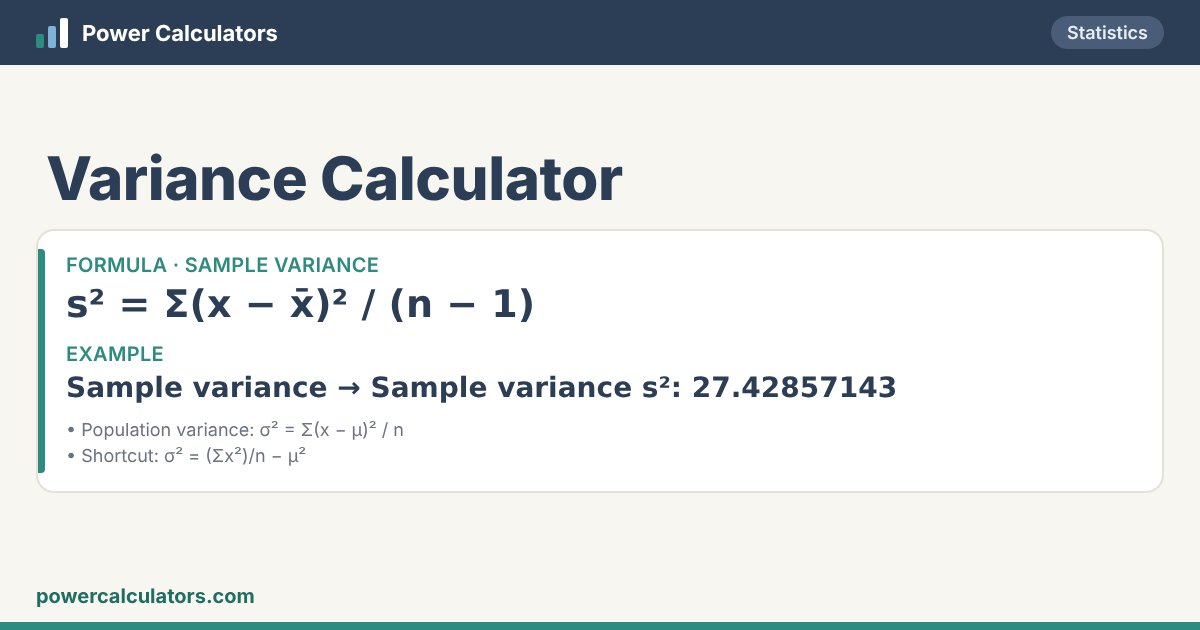
Variance Calculator: Sample variance — s² = Σ(x − x̄)² / (n − 1). Example: Sample variance → Sample variance s²: 27.42857143
How the Variance Calculator works: Sample variance — s² = Σ(x − x̄)² / (n − 1)

Rate this calculator

Was it useful? A quick star rating helps others — and you can leave a comment too.
Rate it: ★ ★ ★ ★ ★

📘 About the Variance Calculator

Variance is the average squared distance of the values from their mean. Squaring makes every deviation positive and gives more weight to values far from the mean. It is the basis of the standard deviation, ANOVA, regression and portfolio risk.

The sample variance divides the sum of squares by n − 1; the population variance divides by n. The calculator gives both, along with the standard deviation (the square root of the variance) and the full table of deviations.

🧮 Formula

Sample variance
s² = Σ(x − x̄)² / (n − 1)
Population variance
σ² = Σ(x − μ)² / n
Shortcut
σ² = (Σx²)/n − μ²

✏️ Worked examples

Sample variance

You enter
Data10, 12, 23, 23, 16, 23, 21, 16
Data is aSample (divide by n − 1)
You get
Sample variance s²27.42857143
Sample standard deviation5.237229366
Population SD σ (÷ n)4.898979486 (variance 24)
Mean18
Count n8
Sum144
Sum of squared deviations192
Standard error of the mean1.8516402
Range10 to 23 (13)
Coefficient of variation29.096%
Within 1 SD of the mean6 of 8 values (75%)

s² = 27.42857143.

Population variance

You enter
Data2, 4, 4, 4, 5, 5, 7, 9
Data is aPopulation (divide by n)
You get
Population variance σ²4
Population standard deviation2
Sample SD s (÷ (n − 1))2.138089935 (variance 4.571428571)
Mean5
Count n8
Sum40
Sum of squared deviations32
Standard error of the mean0.75592895
Range2 to 9 (7)
Coefficient of variation40%
Within 1 SD of the mean6 of 8 values (75%)

σ² = 4.

🧭 How to use this calculator

What you enter

  • DataSeparate numbers with commas, spaces or new lines.
  • Data is a

What you get

  • Sample variance s²
  • Sample standard deviation
  • Population SD σ (÷ n)
  • Mean
  • Count n
  • Sum
  • Sum of squared deviations
  • Standard error of the mean
  • Range
  • Coefficient of variation
  • Within 1 SD of the mean

❓ Frequently asked questions

Why is variance squared?

Squaring makes negative and positive deviations count equally and is mathematically convenient — variances of independent variables add up.

Can variance be negative?

No. It is a sum of squares divided by a positive number, so it is 0 (all values equal) or more.

When do I divide by n − 1?

When the data are a sample. Dividing by n − 1 makes the sample variance an unbiased estimate of the population variance.