🩺 Breast Cancer Risk Calculator

Estimate breast cancer risk using age, family history, reproductive factors, previous breast biopsies and atypical hyperplasia.

5.0 out of 5 (2 ratings)

Enter details

This calculator is intended for women aged 35 years and older.

Log in or create a free account to save your inputs and results, so you don't have to enter them again next time.🔒 No spam, ever. We never sell or share your details, and you can delete your history or account at any time. Privacy policy

Fill in the details and click Calculate to see your results.

Formula at a glance

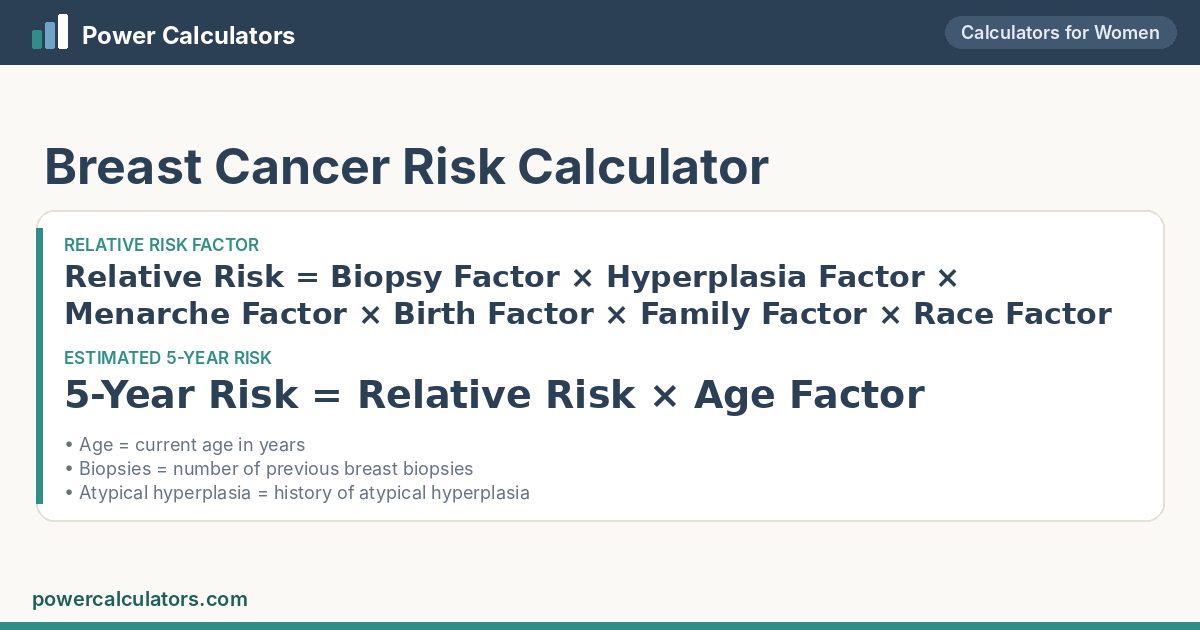
Breast Cancer Risk formula: Relative Risk = Biopsy Factor × Hyperplasia Factor × Menarche Factor × Birth Factor × Family Factor × Race Factor; 5-Year Risk = Relative Risk × Age Factor
How the breast cancer risk works: Relative Risk = Biopsy Factor × Hyperplasia Factor × Menarche Factor × Birth Factor × Family Factor × Race Factor

Rate this calculator

Was it useful? A quick star rating helps others — and you can leave a comment too.
Rate it: ★ ★ ★ ★ ★

📘 About the Breast Cancer Risk Calculator

Breast cancer risk can be influenced by several personal, reproductive and family-history factors.

This calculator combines selected risk factors to provide an educational estimate.

The result is not a diagnosis and should not replace an individual medical risk assessment.

🧮 Formula

Relative risk factor
Relative Risk = Biopsy Factor × Hyperplasia Factor × Menarche Factor × Birth Factor × Family Factor × Race Factor
Estimated 5-year risk
5-Year Risk = Relative Risk × Age Factor

Where

  • Age = current age in years
  • Biopsies = number of previous breast biopsies
  • Atypical hyperplasia = history of atypical hyperplasia
  • Menarche = age category at first menstrual period
  • First live birth = age category at first live birth
  • First-degree relatives = number of first-degree relatives with breast cancer
The calculator combines selected risk-factor multipliers to estimate a relative risk factor and an estimated 5-year risk.

✏️ Worked examples

40-year-old, no risk factors

You enter
Current Age40 years
Race / EthnicityWhite
Number of Previous Breast BiopsiesNone
History of Atypical HyperplasiaNo
Age at First Menstrual Period12-13 years
First-Degree Relatives with Breast CancerNone
Age at First Live Birth20-24 years
You get
Estimated 5-year risk0.45%
Risk levelAverage range
Woman of the same age with no listed risk factors0.45%
Relative risk factor1× the reference level
Chance of NOT developing breast cancer in 5 years99.55%

Estimated 5-year risk 0.45% — Average range.

55-year-old, one biopsy, mother had breast cancer

You enter
Current Age55 years
Race / EthnicityWhite
Number of Previous Breast BiopsiesOne
History of Atypical HyperplasiaNo
Age at First Menstrual Period12-13 years
First-Degree Relatives with Breast CancerOne
Age at First Live Birth20-24 years
You get
Estimated 5-year risk1.31%
Risk levelAverage range
Woman of the same age with no listed risk factors0.75%
Relative risk factor1.74× the reference level
Chance of NOT developing breast cancer in 5 years98.7%

Estimated 5-year risk 1.31% — Average range.

🧭 How to use this calculator

What you enter

  • Current Age (years)This calculator is intended for women aged 35 years and older.
  • Race / Ethnicity
  • Number of Previous Breast Biopsies
  • History of Atypical Hyperplasia
  • Age at First Menstrual Period
  • First-Degree Relatives with Breast Cancer
  • Age at First Live Birth

What you get

  • Estimated 5-Year Risk
  • Relative Risk Factor

💡 Understanding Your Risk Factor

  • The Relative Risk Factor is a multiplier produced from the risk factors entered into the calculator.
  • A value of 1.00 represents the reference level used by this simplified educational calculation.
  • A value above 1.00 means the combination of entered factors produces a higher calculated relative risk than the reference level.
  • A value below 1.00 means the combination of entered factors produces a lower calculated relative risk than the reference level.
  • For example, a Relative Risk Factor of 1.50 means the calculated relative risk multiplier is 1.5 times the reference level used by this calculator.
  • The Relative Risk Factor is not the percentage chance of developing breast cancer.
  • The Estimated 5-Year Risk is the percentage displayed separately and should not be confused with the Relative Risk Factor.
  • This calculator uses a simplified educational calculation and should not be interpreted as an official clinical risk assessment.

💡 Important limitation

  • This is an educational risk estimate and not a diagnosis.
  • Risk models have limitations and may not apply to every person.
  • Women with strong hereditary cancer risk may require a different clinical risk assessment.
  • Discuss your individual breast cancer risk and screening needs with a qualified healthcare professional.

❓ Frequently asked questions

What is a breast cancer risk calculator?

A breast cancer risk calculator estimates the likelihood of developing breast cancer over a specified period using selected personal, reproductive and family-history factors.

What does the Relative Risk Factor mean?

The Relative Risk Factor is a multiplier calculated from the risk factors entered. A value of 1.00 represents the reference level used by this simplified educational calculation. Values above 1.00 indicate a higher calculated relative risk than the reference level, while values below 1.00 indicate a lower calculated relative risk.

Is the Relative Risk Factor a percentage?

No. The Relative Risk Factor is a multiplier, not a percentage. For example, 1.50 represents a multiplier of 1.5 relative to the reference level. The Estimated 5-Year Risk is displayed separately as a percentage.

What factors are included in this calculator?

The calculator considers age, race or ethnicity, previous breast biopsies, atypical hyperplasia, age at first menstrual period, age at first live birth and first-degree family history.

Does this calculator diagnose breast cancer?

No. A risk estimate does not diagnose breast cancer. Screening and diagnostic decisions should be discussed with a qualified healthcare professional.

What does the 5-year risk mean?

The 5-year risk is an estimated percentage representing the likelihood calculated by this educational model over the next five years based on the entered factors.

Can I use this result instead of seeing a doctor?

No. The result is for informational and educational purposes and should not replace an individual assessment by a qualified healthcare professional.

What people are saying
★★★★★
Anonymous · 30 Sep 2026
★★★★★
Anonymous · 30 Sep 2026