Find your estimated body shape using bust, waist and hip measurements. Identify whether your proportions are closest to hourglass, pear, rectangle, inverted triangle or apple.
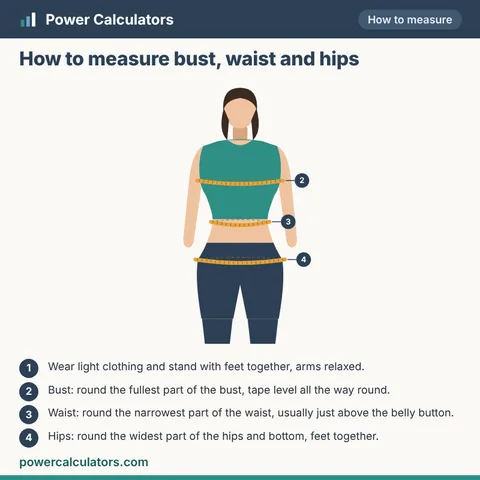
📏 How to measure bust, waist and hipsTap to see the illustrated guide
Wear light clothing and stand with feet together, arms relaxed.
Bust: round the fullest part of the bust, tape level all the way round.
Waist: round the narrowest part of the waist, usually just above the belly button.
Hips: round the widest part of the hips and bottom, feet together.
💾Log in or create a free account to save your inputs and results, so you don't have to enter them again next time.🔒 No spam, ever. We never sell or share your details, and you can delete your history or account at any time. Privacy policy
Fill in the details and click Calculate to see your results.
Share this calculator
Send it to friends and family — it's free.
Formula at a glance
How the body shape works: Bust-to-Hip Ratio = Bust ÷ Hip
Rate this calculator
Was it useful? A quick star rating helps others — and you can leave a comment too.
Rate it:★★★★★
+ Add a comment (optional)
📘 About the Women Body Shape Calculator
The Women Body Shape Calculator estimates your general body shape using three measurements: bust, waist and hip circumference.
The calculator compares the relative proportions of your bust and hips and the difference between your waist and those measurements.
It provides an estimated classification into five commonly used descriptive body-shape categories: Hourglass, Pear, Rectangle, Inverted Triangle and Apple.
Body-shape classifications describe proportions and are not medical diagnoses or measurements of health.
The result is an approximation because body proportions can be affected by height, bone structure, posture, muscle distribution and where measurements are taken.
Code 1 - Hourglass: Bust and hips are relatively similar in size and the waist is substantially smaller.
Code 2 - Pear: Hips are noticeably larger than the bust and the waist is smaller than the hips.
Code 3 - Rectangle: Bust and hips are relatively similar, but the waist is not substantially smaller.
Code 4 - Inverted Triangle: Bust is noticeably larger than the hips.
Code 5 - Apple: The waist is relatively close to the bust measurement.
💡 How to Measure Your Body
Use a flexible measuring tape.
Measure the bust around the fullest part of the bust.
Measure the waist around your natural waist.
Measure the hips around the fullest part of the hips and buttocks.
Keep the tape level and comfortably snug without pulling it tightly.
Use the same unit for all three measurements.
💡 Understanding the Hourglass Shape
The bust and hips are relatively similar in circumference.
The waist is substantially smaller than both the bust and hips.
The classification is based on proportions rather than total body size.
💡 Understanding the Pear Shape
The hips are noticeably larger than the bust.
The waist is generally smaller than the hip measurement.
The category describes body proportions and does not indicate health or body composition.
💡 Understanding the Rectangle Shape
The bust and hips are relatively similar in size.
The waist is not dramatically smaller than the bust and hips.
The overall measurements therefore have a relatively straight proportion.
💡 Understanding the Inverted Triangle Shape
The bust is noticeably larger than the hips.
The waist may still be smaller than the bust.
The classification describes the relative proportions of the three measurements.
💡 Understanding the Apple Shape
The waist measurement is relatively close to the bust measurement.
The waist does not show the pronounced reduction associated with an hourglass classification.
This category describes proportions and is not a measure of abdominal fat or health.
💡 Body Shape and Clothing
Body-shape categories can be used as an optional starting point for clothing and styling ideas.
There is no single correct way to dress for a particular body shape.
Comfort, personal preference, garment fit, fabric and design are also important.
Your body shape does not determine what clothing you should or should not wear.
💡 Limitations of This Calculator
Body-shape categories are simplified descriptive classifications.
The calculator uses only bust, waist and hip measurements.
It does not account for height, shoulder width, bone structure, posture or muscle distribution.
Small differences in measurement can change the classification when proportions are close to a threshold.
The result should therefore be treated as an approximate classification.
💡 Important Disclaimer
This calculator is for informational and general styling purposes only.
It is not a medical or health assessment.
The classifications are simplified descriptions of body proportions.
The result should not be used to judge health, fitness, attractiveness or body value.
❓ Frequently asked questions
What is a women body shape calculator?
A women body shape calculator estimates general body proportions by comparing bust, waist and hip measurements.
What measurements are needed?
You need your bust, waist and hip circumferences. Enter all three measurements using the same unit, such as centimetres.
What body shapes does this calculator identify?
This calculator uses five descriptive categories: Hourglass, Pear, Rectangle, Inverted Triangle and Apple.
What is an hourglass body shape?
An hourglass classification generally means the bust and hips are relatively similar in size while the waist is substantially smaller.
What is a pear body shape?
A pear classification generally means the hips are noticeably larger than the bust and the waist is smaller than the hips.
What is a rectangle body shape?
A rectangle classification generally means the bust and hips are relatively similar while the waist is not substantially smaller.
What is an inverted triangle body shape?
An inverted triangle classification generally means the bust is noticeably larger than the hips.
What is an apple body shape?
An apple classification in this calculator means the waist measurement is relatively close to the bust measurement.
Can body shape change over time?
Yes. Body proportions can change with age, weight changes, pregnancy, muscle development and other factors.
Is body shape related to body weight?
Body shape describes proportions rather than total body weight. People with different weights can have similar proportions, and people with similar weights can have different proportions.
Is body shape a measure of health?
No. A body-shape classification describes proportions and should not be interpreted as a measure of health, fitness or body composition.
How accurate is this body shape calculator?
It provides an approximate classification based on the measurements entered. Measurement technique and small differences in proportions can affect the result.
Does height affect body shape?
Height can affect how proportions appear visually, but this calculator does not use height. It classifies proportions from bust, waist and hip measurements.
Can I use this calculator for clothing and styling?
Yes. The result can be used as a general styling reference, but personal preference, comfort and garment fit are also important.