≈ Taylor Series Calculator (Maclaurin Series)

Turn a function into a polynomial: f(x) ≈ f(a) + f′(a)(x − a) + f″(a)(x − a)²/2! + …

No ratings yet — be the first

Enter details

Use ^ for powers, * or nothing for ×: 3x^2 + 2sin(x), e^(2x), sqrt(x+1), ln(x).
One letter. Other letters are treated as constants.

Log in or create a free account to save your inputs and results, so you don't have to enter them again next time.🔒 No spam, ever. We never sell or share your details, and you can delete your history or account at any time. Privacy policy

Fill in the details and click Calculate to see your results.

Formula at a glance

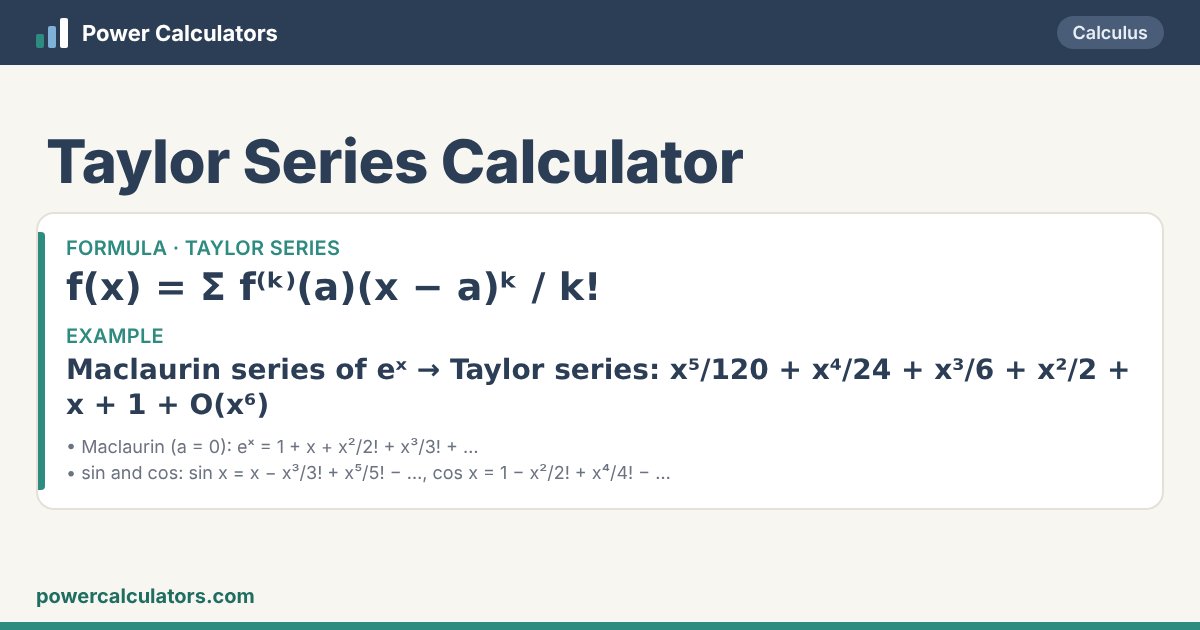
Taylor Series Calculator: Taylor series — f(x) = Σ f⁽ᵏ⁾(a)(x − a)ᵏ / k!. Example: Maclaurin series of eˣ → Taylor series: x⁵/120 + x⁴/24 + x³/6 + x²/2 + x + 1 + O(x⁶)
How the Taylor Series Calculator works: Taylor series — f(x) = Σ f⁽ᵏ⁾(a)(x − a)ᵏ / k!

Rate this calculator

Was it useful? A quick star rating helps others — and you can leave a comment too.
Rate it: ★ ★ ★ ★ ★

📘 About the Taylor Series Calculator

A Taylor series writes a function as an infinite polynomial built from its derivatives at one point. Cut off after a few terms, it gives an excellent approximation near that point — which is how calculators compute sin, cos and eˣ, and how physicists make small-angle approximations like sin θ ≈ θ.

Choose the function, the centre and the order. The calculator differentiates repeatedly, evaluates each derivative at the centre (exactly where possible), divides by k! and assembles the polynomial. The graph compares the polynomial with the function, and you can check the error at any x.

🧮 Formula

Taylor series
f(x) = Σ f⁽ᵏ⁾(a)(x − a)ᵏ / k!
Maclaurin (a = 0)
eˣ = 1 + x + x²/2! + x³/3! + …
sin and cos
sin x = x − x³/3! + x⁵/5! − …, cos x = 1 − x²/2! + x⁴/4! − …

✏️ Worked examples

Maclaurin series of eˣ

You enter
Function f(x)e^x
Variablex
Centre a0
Order (highest power)5
You get
Taylor seriesx⁵/120 + x⁴/24 + x³/6 + x²/2 + x + 1 + O(x⁶)
TypeMaclaurin series (centred at 0), up to order 5
Accuracy at x = 0.5series 1.648697917 vs exact 1.648721271 (error 0.0000234)

x⁵/120 + x⁴/24 + x³/6 + x²/2 + x + 1 + O(x⁶).

sin x to order 7

You enter
Function f(x)sin(x)
Variablex
Centre a0
Order (highest power)7
You get
Taylor series−x⁷/5040 + x⁵/120 − x³/6 + x + O(x⁸)
TypeMaclaurin series (centred at 0), up to order 7
Accuracy at x = 0.5series 0.4794255332 vs exact 0.4794255386 (error 5.37 × 10^-9)

−x⁷/5040 + x⁵/120 − x³/6 + x + O(x⁸).

🧭 How to use this calculator

What you enter

  • Function f(x)Use ^ for powers, * or nothing for ×: 3x^2 + 2sin(x), e^(2x), sqrt(x+1), ln(x).
  • VariableOne letter. Other letters are treated as constants.
  • Centre a
  • Order (highest power)
  • Check accuracy at x = (optional)

What you get

  • Taylor series
  • Type
  • Accuracy at x = 0.5

❓ Frequently asked questions

What is the difference between a Taylor and a Maclaurin series?

A Maclaurin series is a Taylor series centred at 0. Taylor series can be centred at any point a.

How many terms do I need?

More terms give a better approximation over a wider range. The error is roughly the size of the first term you leave out.

What is the Taylor series of ln(1 + x)?

x − x²/2 + x³/3 − x⁴/4 + …, valid for −1 < x ≤ 1.