👥 Sample Size Calculator (Surveys & Studies)

How many people do you need to survey for a ±5% margin of error?

No ratings yet — be the first

Enter details

For a mean, in the data’s units.
Use 50% if unsure.

Log in or create a free account to save your inputs and results, so you don't have to enter them again next time.🔒 No spam, ever. We never sell or share your details, and you can delete your history or account at any time. Privacy policy

Fill in the details and click Calculate to see your results.

Formula at a glance

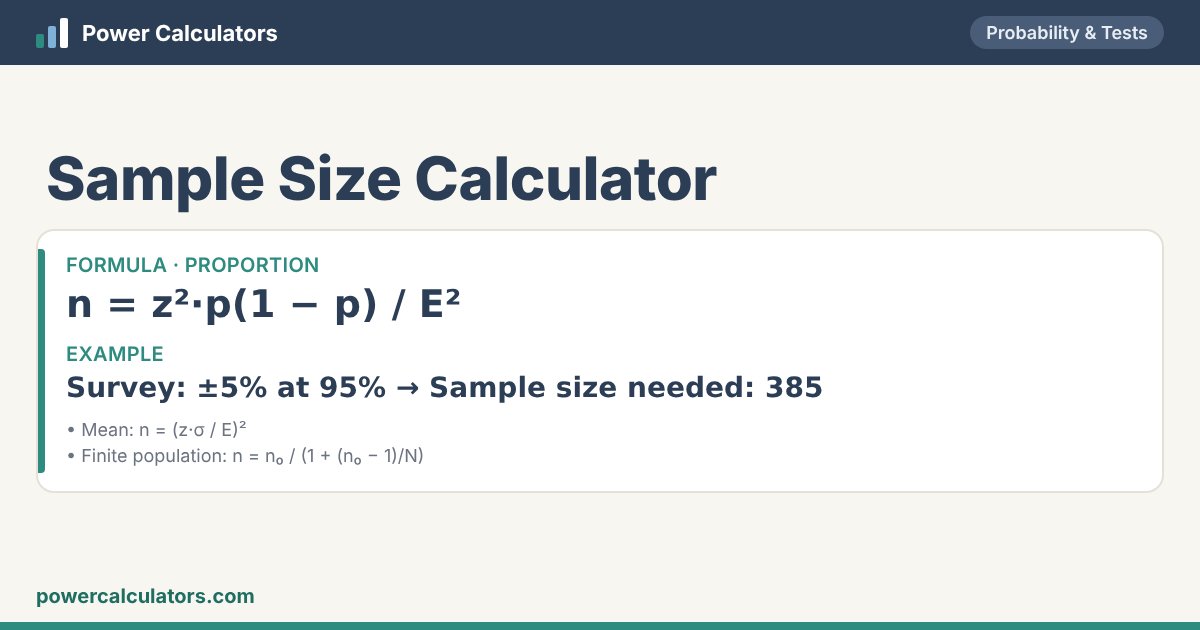
Sample Size Calculator: Proportion — n = z²·p(1 − p) / E². Example: Survey: ±5% at 95% → Sample size needed: 385
How the Sample Size Calculator works: Proportion — n = z²·p(1 − p) / E²

Rate this calculator

Was it useful? A quick star rating helps others — and you can leave a comment too.
Rate it: ★ ★ ★ ★ ★

📘 About the Sample Size Calculator

The sample size determines how precise a survey or study can be. More responses give a smaller margin of error, but the gain slows down: halving the margin of error needs four times the sample. For a large population, ±5% at 95% confidence needs 385 responses; ±3% needs 1,068.

Choose proportion (for percentages, yes/no questions) or mean, the confidence level and margin of error. Add the population size for a finite-population correction, and the expected response rate to see how many invitations to send.

🧮 Formula

Proportion
n = z²·p(1 − p) / E²
Mean
n = (z·σ / E)²
Finite population
n = n₀ / (1 + (n₀ − 1)/N)

✏️ Worked examples

Survey: ±5% at 95%

You enter
Estimating aProportion / percentage (surveys)
Confidence level95%
Margin of error5%
Expected proportion50%
Standard deviation (for a mean)15
Expected response rate100%
You get
Sample size needed385
Before rounding up384.14588
Confidence · z95% · 1.96

385 responses.

2,000 employees, 30% response

You enter
Estimating aProportion / percentage (surveys)
Confidence level95%
Margin of error5%
Expected proportion50%
Standard deviation (for a mean)15
Population size (optional)2000
Expected response rate30%
You get
Sample size needed323
Before rounding up322.38554
Confidence · z95% · 1.96
Finite population correctionn = n₀ ÷ (1 + (n₀ − 1)/N) with n₀ = 384.146, N = 2,000
Invitations to send at 30% response1,077

323 responses.

🧭 How to use this calculator

What you enter

  • Estimating a
  • Confidence level (%)
  • Margin of error (%)For a mean, in the data’s units.
  • Expected proportion (%)Use 50% if unsure.
  • Standard deviation (for a mean)
  • Population size (optional)
  • Expected response rate (%)

What you get

  • Sample size needed
  • Before rounding up
  • Confidence · z

❓ Frequently asked questions

Why is 385 the magic number?

With 95% confidence, ±5% margin and p = 50%, n = 1.96² × 0.25 / 0.05² ≈ 384.2, rounded up to 385.

Does the population size matter?

Only when the sample is a sizeable share of it. For populations above about 20,000 the sample size barely changes.

Why use p = 50%?

It gives the largest sample size, so you are safe whatever the true proportion turns out to be.